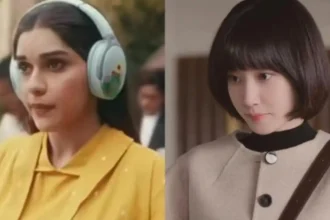









Janhvi Kapoor has spoken out against the circulation of an AI-manipulated video using footage from Chuttamalle, calling the misuse of technology to objectify women without their consent “deeply violating” and saying that respect for a woman’s body and boundaries should never be negotiable.
Janhvi Kapoor has addressed the circulation of a digitally manipulated video featuring footage of her from the song Chuttamalle, from her film Devara: Part 1 with Jr NTR.
Taking to Instagram Stories, the actor condemned the use of technology to create and distribute fictionalised sexualised content involving women without their permission. She described the practice as a serious violation of personal boundaries and connected the incident to the broader problem of how women continue to face unwanted scrutiny, objectification and harassment.
Janhvi Kapoor: ‘Kindness, consent and respect should be basic’
In her statement, Janhvi argued that technological advances should not be used as a tool to remove a person’s right to control their own image.
“The criminal misuse of technology to objectify women and circulate fictionalised content without consent is deeply violating, bordering on sexual assault.”
She added that the problem extends beyond the entertainment industry, saying that women in different walks of life are increasingly being exposed to similar forms of digital abuse.
For Janhvi, the central issue is consent.
“Consent, choice and respect for a woman’s body should be among the most basic notions of humanity.”
She stressed that consent is specific to a particular situation and can be withdrawn or changed at any point. A person’s clothing, previous choices or earlier consent, she argued, cannot be interpreted as permission for something else.
Janhvi illustrated the point by saying that even if a woman agrees to something repeatedly, she has the right to say no later, and that decision must be respected.
Her larger argument was that what a woman wears, how she presents herself and where she chooses to establish personal boundaries do not give anyone permission to digitally manipulate, record or exploit her image.
‘The threat has now expanded into the digital sphere’
Janhvi said the incident also made her think about a much wider issue facing women.
According to the actor, the conversation cannot stop at the removal of an individual AI-generated video. She linked the controversy to the everyday reality of women navigating safety concerns, social judgement and unwanted attention.
“It is about the larger reality of being a woman, the gaze, the judgement, the constant negotiation for safety, and the feeling that our boundaries somehow remain open to interpretation.”
She also pointed out that the digital environment has created another avenue through which personal boundaries can be violated.
“That threat has now expanded into the digital sphere, when we have not even adequately addressed the very real, physical fear that continues to disrupt the lives of women every day.”
The comments highlight one of the growing concerns surrounding generative AI: manipulated images and videos can be created or altered without the involvement or permission of the person depicted, potentially turning someone’s existing photographs or footage into material they never agreed to produce.
Janhvi says the solution cannot simply be ‘protect your daughter’
Janhvi also questioned the idea that the responsibility for preventing such violations should primarily fall on women and their families.
She argued that society must also challenge the conditioning that allows some people to believe they are entitled to cross another person’s boundaries.
The actor called for greater accountability and suggested that influential men have an important role to play in challenging behaviour that objectifies or violates women.
For her, meaningful change requires more than advising women to be cautious. It also requires confronting the attitudes that normalise harassment and entitlement.
Janhvi thanks Jr NTR and others for speaking up
Janhvi expressed gratitude to several public figures who supported her after the manipulated video circulated.
She specifically thanked Jr NTR, Chiranjeevi, Vijay Deverakonda and Khushbu Sundar for condemning the incident and speaking about the wider issue.
Janhvi said she was particularly moved by Jr NTR’s response.
“I am deeply touched by NTR sir for taking such a strong stand and condemning this violation. Thank you, sir.”
She said that when influential public figures speak about an issue that may not directly affect them, it can still have an impact on women who have experienced similar behaviour.
She also thanked Chiranjeevi, Vijay Deverakonda and Khushbu Sundar for amplifying the message and calling for action against what she described as immoral practices.
The bigger debate around AI and digital consent
The controversy comes at a time when generative AI has made sophisticated image and video manipulation increasingly accessible.
While synthetic media can have legitimate creative and entertainment applications, its misuse to create sexualised or otherwise harmful material involving real people has raised significant concerns around consent, privacy, dignity and online safety.
For public figures, the problem can be particularly difficult because photographs, film footage and interviews are already widely available online. However, the availability of someone’s existing content does not automatically amount to permission to transform it into something they did not create or consent to.
Janhvi’s statement therefore moves the discussion beyond one particular video and towards a fundamental question about digital identity: who gets to decide how a person’s image is used?
Her answer is clear—the person depicted should retain agency over their own body, image and boundaries.
‘Is it really too much’ to ask for dignity?
Janhvi ended her statement with a question about the most basic expectation of personal dignity.
“Is it really too much for a woman to ask to simply be treated and seen as a human being?”
She followed that sentiment by emphasising the importance of a woman’s body, image, boundaries and choices.
The actor’s response has consequently become part of a much broader conversation about technology, consent and the responsibilities that come with increasingly powerful digital tools.
Rather than treating AI manipulation as merely another form of online trolling, Janhvi’s statement asks audiences to consider the real-world consequences of turning a person’s image into something they never agreed to create.
Janhvi Kapoor’s work front
Janhvi Kapoor was most recently seen in the Telugu film Peddi, alongside Ram Charan.
The actor continues to work across Hindi and Telugu cinema, while her latest comments have placed the focus away from her films and towards an issue affecting women and public figures in the rapidly evolving digital landscape.