








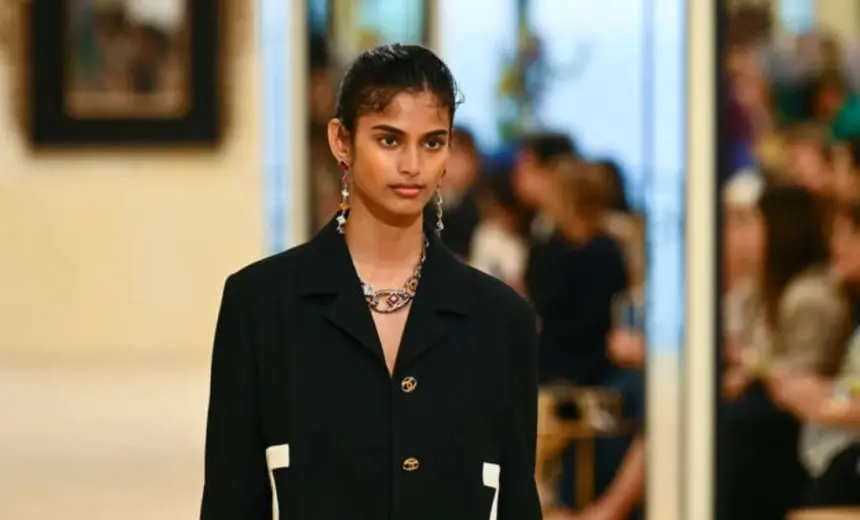
Bhavitha Mandava made her debut at the BoF 500 gala in Paris, but it was her mother’s elegant silk saree that quickly became one of the most talked-about elements of the family’s red-carpet appearance.
Bhavitha Mandava stepped onto one of fashion’s most influential global stages with her family by her side, attending the BoF 500 gala in Paris for the first time.
The appearance brought together two very different expressions of fashion. Bhavitha embraced the world of international luxury with a Chanel look, while her mother arrived in a traditional silk saree that drew considerable appreciation online.
What could have been a conventional high-fashion red-carpet moment instead became a celebration of Indian style alongside global couture.
Bhavitha Mandava makes her BoF 500 debut
The BoF 500 is closely associated with some of the most influential names across the international fashion industry, making an appearance at its gala a significant fashion moment.
For Bhavitha, the occasion marked her debut at the event.
She attended the Paris gala with her parents, bringing a distinctly personal element to an otherwise highly glamorous industry gathering. Her appearance in Chanel placed her firmly within the contemporary luxury-fashion conversation, while her family’s presence added another dimension to the occasion.
But as photographs from the event circulated online, attention quickly shifted towards another member of the family.
Her mother’s silk saree becomes the surprise fashion highlight
Bhavitha’s mother appeared in a traditional silk saree, creating a striking contrast with the Western couture surrounding her at the gala.
The saree’s timeless character stood apart from the structured luxury associated with a global fashion house. Rather than looking out of place at an international fashion event, the traditional ensemble became a reminder that Indian craftsmanship and styling can hold their own in any fashion setting.
Social-media users were quick to praise her appearance, with some suggesting that the saree was just as striking as Bhavitha’s Chanel outfit—and, for some viewers, even more elegant.
The response reflects something that frequently happens at major international fashion events: audiences increasingly appreciate red-carpet appearances not only for the designer label involved, but also for the cultural identity communicated through the clothing.
Chanel and the saree create a memorable contrast
The visual contrast between mother and daughter made the family appearance particularly interesting.
Bhavitha’s Chanel ensemble represented the polished language of contemporary European luxury, while her mother’s silk saree carried the visual vocabulary of Indian traditional dressing.
Neither look needed to compete with the other.
Instead, the two outfits demonstrated how fashion can move between cultures without one expression having to replace another. A saree can appear on the same red carpet as couture and still command attention through its own craftsmanship, silhouette and cultural significance.
That contrast also made the appearance feel more personal than a standard celebrity fashion moment.
An Indian fashion moment in Paris
Indian representation at international fashion events has increasingly become part of the global fashion conversation.
From designers and models to actors, entrepreneurs and fashion personalities, Indian figures are appearing more frequently at events that shape the industry’s international dialogue.
The Mandava family’s appearance offered a particularly straightforward version of that cultural exchange.
Bhavitha represented the contemporary global luxury space, while her mother brought Indian traditional dressing directly into the same environment.
The result was not a choice between Indian and Western fashion. It was an example of how the two can exist together.
Why the saree resonated with audiences
Part of the appeal of the saree lies in its ability to remain recognisable while adapting to different settings.
At a high-profile Paris gala, the silk saree retained its cultural identity without requiring a dramatic reinvention.
That may explain why the look resonated with social-media audiences. While Bhavitha’s Chanel appearance naturally attracted attention because of the fashion house’s global status, her mother’s traditional outfit offered something different: familiarity, elegance and cultural pride.
The online reaction also illustrates how fashion audiences are increasingly interested in the story behind an outfit—not just its price tag or designer name.
A family appearance that became a fashion conversation
Bhavitha Mandava’s BoF 500 debut was expected to be a significant moment for her own fashion profile. Yet the evening also became a showcase of the power of traditional Indian dressing.
Her Chanel look and her mother’s silk saree represented two distinct fashion languages, but their appearance together made the contrast feel complementary rather than contradictory.
In a city synonymous with haute couture, the saree served as a reminder that Indian fashion does not need to imitate global trends to make an impression.
Sometimes, its strongest statement comes from simply wearing it with confidence.