






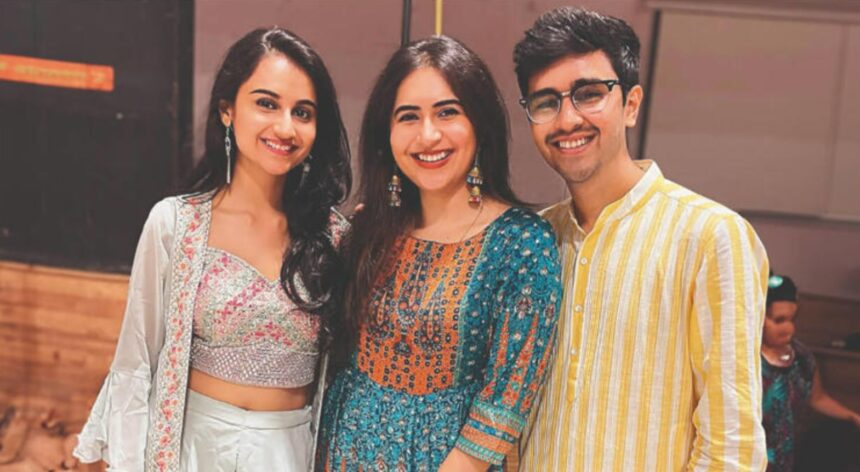
For Vyoma Nandi and her younger siblings, twins Heema and Hard, Raksha Bandhan is more than a date on the calendar. It is a celebration filled with family rituals, childhood memories, playful teasing and the kind of sibling chaos that remains familiar even as life takes them across different countries and careers.
While Vyoma and her siblings have spent much of their lives navigating the distance between Canada and India, the festival has continued to hold a special place in their family.
From traditional outfits and homemade sweets to video calls across time zones, the three siblings have found ways to keep their Raksha Bandhan traditions alive.
‘Festivals Were Always Huge Events for Our Family’
Growing up away from India made cultural celebrations especially meaningful for the family, Vyoma said.
See more of our coverage in your search results.
Add Hunterfly on Google“Living far from India made us cling even tighter to our roots, so festivals like Raksha Bandhan were always huge events for our family,” she shared.
Vyoma recalled waking up early during Shravan, dressing in traditional clothes and enjoying the festive atmosphere at home.
“Mummy would prepare an incredible spread, including hot sukhdi, and we’d excitedly wait for the muhurta to tie the rakhi and finally feast,” she said.
For families living outside India, festivals can often become an important way of maintaining a connection with traditions, food and shared cultural memories.
For Vyoma, Heema and Hard, Raksha Bandhan became one such occasion.
See more of our coverage in your search results.
Add Hunterfly on GoogleA Day of Affection—and Plenty of Teasing
Heema described Raksha Bandhan as one of the family’s most cherished celebrations.
“Raksha Bandhan is particularly dear to us; Didi and I love to shower affection on—and thoroughly annoy—our younger brother, Hard,” she said.
The tradition includes tying rakhis, spending time together and, of course, waiting for gifts.
See more of our coverage in your search results.
Add Hunterfly on Google“On the day, we tie cute rakhis on his wrist and eagerly await our gifts. He invariably pretends he has bought us nothing, teasing us for a while before finally handing over the money,” Heema said.
For Hard, the childhood rituals carried their own sense of excitement.
He remembered dressing in traditional clothes and sitting before the family’s home mandir for the ceremony.
“I fondly remember dressing up in traditional clothes and sitting in front of the home mandir to tie the rakhi, always looking forward to the puran poli my mum made,” he said.
As a child, he also had his own imaginative interpretation of the festival.
“I genuinely felt those rakhis gave me a superpower to protect my sisters,” Hard recalled. “It sounds funny now, but it felt wonderful and was my favourite part of Raksha Bandhan.”
From Small Envelopes to Bigger Gift Expectations
Like many sibling traditions, Raksha Bandhan celebrations have also changed as the three have grown older.
Vyoma admitted that when Hard was younger, expensive gifts were never really part of the equation.
“Just being together was the real fun,” she said, adding that as Hard grew up, even a Raksha Bandhan call became meaningful.
But now, she joked, expectations have changed.
“Now that he’s older, I’m expecting him to pay up with some good gifts!” Vyoma said.
Heema recalled that their mother often handled the gifting tradition.
“Mum usually decides on what to give us for Rakhi—usually just five or ten dollars in envelopes,” she said.
However, she and Vyoma now believe it may be time for an upgrade.
“Now that we’re getting older, Didi and I have both decided it’s time to ask for a real present,” she added.
Hard, meanwhile, said some of their most memorable celebrations involved experiences rather than physical gifts.
The siblings would sometimes go out for an iced cappuccino and something to eat, turning that shared outing into a Raksha Bandhan tradition of its own.
“For us siblings, it was always about the bonding experience,” Hard said, even though his sisters would jokingly protest, “This doesn’t count as a gift!”
How They Celebrate Raksha Bandhan Across Distance
As the siblings have grown older and spent time in different places, celebrating together physically has not always been possible.
But distance has not stopped them from maintaining their traditions.
Heema explained that when they are not under the same roof, technology helps bring the family together.
“Hard and I get up early and dress up nicely for photos before video calling my sister so she can join in,” she said.
Vyoma remains connected to the ritual through the video call while the ceremony takes place at home.
“She stays on call throughout the entire ritual in the puja room as we apply the tilak on my brother and tie the rakhis,” Heema explained.
The family also continues to share traditional sweets, including homemade laddus.
Hard said there have also been occasions when he has celebrated early with Vyoma during trips to India so that she can physically tie the rakhi.
But with age, he has also come to see the festival in a broader way.
“As we grow older, we realise Raksha Bandhan reflects our relationship but does not create it; sibling love is something to foster all year round,” he said.
The Eldest Sister and the Twin Team
Their relationship today is filled with the same affection—and mischief—that defined their childhood.
As the eldest sibling, Vyoma described herself as naturally protective of her younger brother and sister.
“Being the eldest child, I am naturally very protective of my siblings and have a strong motherly instinct toward them,” she said.
But because Heema and Hard are twins, their sibling dynamic can sometimes turn into a two-against-one situation.
Heema said she and Hard enjoy teasing their elder sister.
“Hard and I love annoying our sister—being twins, it is usually two against one when it comes to pranks,” she said.
Hard, however, had his own memories of being outnumbered.
“The two of them would join forces against me, using me as a test dummy for random hairstyles and makeup—classic sister behaviour,” he joked.
The playful teasing appears to be an essential part of how the three siblings connect.
Supporting Each Other in the Entertainment Industry
The siblings also share a professional connection through the entertainment industry.
Vyoma said that when her younger siblings began exploring their own careers, she initially felt strongly protective and tried to guide them based on her own experiences.
Over time, however, they realised that each person needed to find their own path.
“I used to help them with their initial auditions, but now they are thriving independently and only seek my advice when needed,” Vyoma said.
She added that her own experience navigating professional and cultural differences between Canada and India has helped her guide her siblings.
“The communication styles and work cultures vary drastically,” she said, explaining that her advice often focuses on helping them understand subtle differences and avoid misunderstandings.
Heema said having an elder sister with industry experience provides confidence.
“The fact that she is an actress makes a huge difference to us,” she said. “It boosts our confidence knowing we can always lean on her experience whenever we get stuck.”
Hard echoed that sentiment, saying Vyoma had helped create a foundation from which he and Heema could build their own journeys.
“Having someone like her to look up to gives us immense strength and invaluable lessons from her own experiences,” he said.
A Real-Life Version of Tripling?
When asked to describe their three-sibling equation, Vyoma pointed to the popular series Tripling.
The show may feature two brothers and a sister, while Vyoma’s family includes two sisters and a brother, but she said the basic eldest-middle-youngest sibling dynamic feels relatable.
“The interplay between the eldest, middle and youngest siblings feels spot-on for the three of us,” she said.
One tradition that has remained consistent is the family’s preference for Rudraksha rakhis.
Vyoma and Heema recalled how seriously Hard took the ritual when he was younger.
“Ever since he was a young child, our brother would always insist, ‘Tie it properly so it doesn’t come loose,’” they recalled.
He would make sure the rakhi remained on his wrist for as long as possible—sometimes until the next Raksha Bandhan.
More Than a Festival
For Vyoma, Heema and Hard, Raksha Bandhan is ultimately about much more than rituals or gifts.
Their memories are filled with family meals, traditional clothing, homemade sweets, pranks and arguments.
Today, even when they are separated by distance, they continue to adapt their celebrations through video calls and shared traditions.
Their story reflects a reality familiar to many families living across countries: traditions may change with time and geography, but the relationships behind them can remain deeply rooted.
This Raksha Bandhan, the three siblings offered a warm and playful reminder that the strongest family bonds are often built in the everyday moments—the teasing, the disagreements, the laughter and the decision to keep showing up for one another, no matter the distance.