





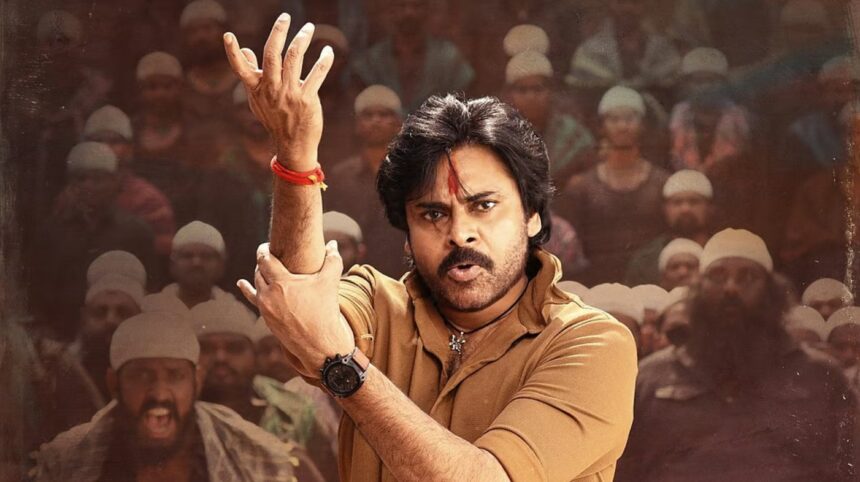
A Film Overpowered by Messaging
Ustaad Bhagat Singh, directed by Harish Shankar and starring Pawan Kalyan, sets out to be a mass entertainer but ends up functioning more as a politically charged narrative.
Despite expectations of a commercial blockbuster, the film leans heavily into ideological themes, often at the cost of storytelling and cinematic engagement.
Weak Narrative, Strong Agenda
The plot revolves around an undercover cop tackling crime and political conspiracies. However, the story feels thin and largely secondary to the film’s messaging.
Instead of a cohesive screenplay, the narrative unfolds as a series of loosely connected episodes. The lack of structure makes it difficult for the audience to stay invested.
See more of our coverage in your search results.
Add Hunterfly on GoogleMoments that could have added emotional depth are overshadowed by repetitive and overt ideological cues.
Politics Takes Center Stage
The film’s most defining aspect is its strong political undertone.
Rather than maintaining a balance between narrative and commentary, the film consistently prioritizes messaging. This approach blurs the line between cinema and political expression, making the viewing experience feel heavy-handed.
Attempts to include neutral or balanced dialogue do little to offset the dominant tone, which remains firmly driven by a specific ideological perspective.
Disjointed Screenplay and Logical Gaps
Structurally, the film struggles with coherence.
See more of our coverage in your search results.
Add Hunterfly on GoogleThe non-linear storytelling, shifting timelines, and abrupt transitions create a fragmented viewing experience. The first and second halves feel disconnected, with several plot points lacking proper development or resolution.
Key events unfold without emotional impact, reducing the overall effectiveness of the narrative.
Underdeveloped Characters
The film does not provide adequate depth to its characters.
See more of our coverage in your search results.
Add Hunterfly on GoogleRaashii Khanna and Sreeleela are given limited scope, with their roles serving more as narrative tools than fully realized characters.
Other actors, including R. Parthiban and K. S. Ravikumar, appear in significant roles but are not given enough material to leave a lasting impression.
Technical Aspects and Tone
Visually and tonally, the film resembles older mainstream commercial cinema.
The background score by S. Thaman amplifies key moments but often feels excessive. The overall technical execution does little to elevate the weak screenplay.
Missed Opportunity as a Mass Entertainer
Given the combination of a popular star and a commercially successful director, the film had the potential to deliver a compelling mass entertainer.
However, the overemphasis on messaging, coupled with weak writing and lack of coherence, turns it into a tiring experience.
Final Verdict
Ustaad Bhagat Singh stands as a film where narrative, character development, and cinematic depth are overshadowed by heavy-handed messaging.
What could have been an engaging mass entertainer instead becomes a disjointed and ideologically driven project that struggles to connect on a storytelling level.
Rating
2 / 5
Disclaimer
This review is based on an analytical perspective of the film’s storytelling, performances, and overall execution. Viewer interpretations may vary.