








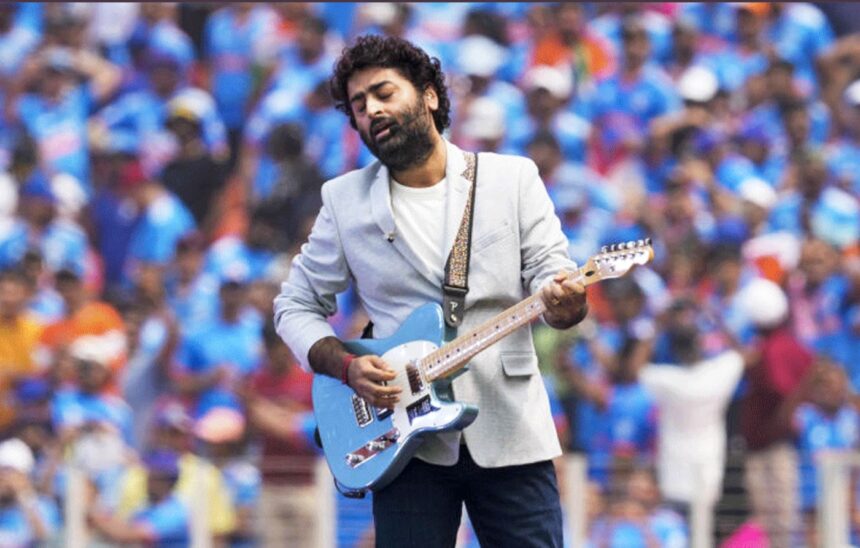
Playback singers in India, much like politicians, rarely retire.
Some pass away while still commanding the spotlight. Others gradually fade as new voices take over recording studios. Very few make a conscious choice to stop.
Arijit Singh did.
On Tuesday evening, one of Hindi cinema’s most influential voices announced that he would no longer take up new playback singing assignments—a declaration that instantly sent shockwaves through the music industry and his global fan base.
See more of our coverage in your search results.
Add Hunterfly on Google“I am happy to announce that I am not going to be taking any new assignments as a playback vocalist from now on. I am calling it off. It was a wonderful journey,” Arijit wrote on social media, thanking listeners for years of unwavering support.
For an artist whose voice has shaped the emotional vocabulary of modern Bollywood, the decision marks the end of an era—but not the end of music.
A Departure Years in the Making
While the announcement felt sudden, Arijit’s withdrawal from the spotlight began quietly over a decade ago.
At the peak of his commercial success, he walked away from Mumbai’s relentless pace and returned to Jiaganj, his hometown on the banks of the Bhagirathi in Murshidabad. The move puzzled many at the time, but for Arijit, it was the first step toward reclaiming control over his life and art.
Tuesday night’s announcement merely formalised a choice that had long been taking shape.
See more of our coverage in your search results.
Add Hunterfly on Google“At the height of their powers, some artists step away—not from art but from noise,” filmmaker Mahesh Bhatt told The Telegraph Online. “They choose silence, solitude, and truth over constant performance.”
The Afternoon That Changed Hindi Film Music
Bhatt’s memories of Arijit trace back to the making of Mohit Suri’s Aashiqui 2 (2013), a film that redefined the sound of cinematic romance.
“When I heard about Arijit’s decision, I was unexpectedly taken back to an afternoon at Super Sound Service in Khar—the old T-Series building—where the journey of Aashiqui 2 truly began,” Bhatt recalled.
See more of our coverage in your search results.
Add Hunterfly on GoogleAs the music was being released, Arijit was called to sing Tum Hi Ho.
“A shy, self-effacing young man walked up to the dais and sang a song that would quietly mesmerise the world,” Bhatt said. “That moment became a springboard into a life that would never be the same again.”
Tum Hi Ho didn’t just become a chartbuster—it altered how Hindi films expressed love. What followed was an extraordinary run of hits that made Arijit Singh the defining voice of a generation.
Beyond Playback: A Complete Musician
Composer Anu Malik, who worked with Arijit on Begum Jaan (2017), describes him as far more than a playback singer.
“He is phenomenal—a prodigy—but also one of the most grounded and sorted individuals I’ve met,” Malik said. “He sings, plays instruments, arranges music, understands programming and production. He is a complete musician.”
Their collaboration resulted in just one song, but Malik vividly recalls Arijit’s perfectionism in the studio.
“He must have asked for a hundred takes,” Malik said. “I would say it’s okay, but he would insist on one more.”
Malik admits regret that they never collaborated again but respects Arijit’s decision. “There must be a good reason. Thankfully, he will continue as an independent musician.”
A Global Voice, Rooted at Home
Arijit’s influence extends far beyond Bollywood.
At least twice, he has overtaken Taylor Swift to become the most-streamed artist on Spotify globally. His voice has remained the most listened-to among Indian musicians for years. He brought Ed Sheeran to Jiaganj for a collaboration and continued creating music and films from a town far removed from the glamour of Mumbai.
Despite global acclaim, he never chased celebrity.
Playback singing, he once told Javed Akhtar, was never his final destination. He always wanted to compose, to build, to create outside the rigid framework of Hindi cinema.
Not an Exit, but a Return
“So his choice today doesn’t provoke a ‘why’ in me,” Mahesh Bhatt reflected. “Because a voice that has already given itself so fully to the world sometimes needs to return home—to itself.”
Arijit Singh may have stepped away from playback singing, but he has not stepped away from music.
He has simply chosen where—and how—he wants to sing.
Arijit Singh is at home.