





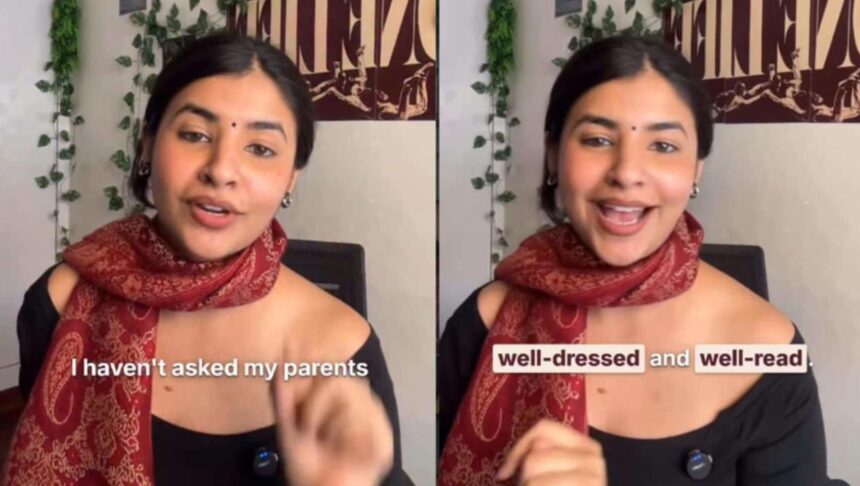
A 23-year-old woman named Shreya has shared how she manages her earnings through three financial buckets dedicated to investments, lifestyle expenses and emergency savings. Her approach offers practical money management insights for young professionals seeking financial independence.
Financial independence can mean different things to different people. For 23-year-old Shreya, it means managing her own expenses, investing regularly, preparing for unexpected financial challenges and supporting her family.
In a video shared on social media, Shreya revealed that she has not asked her parents for money since the age of 19, when she began earning an internship stipend while working at the Royal Bank of Scotland.
Four years later, she says her financial habits have enabled her to sponsor an international trip for her father.
Rather than presenting the achievement as a measure of success, Shreya explained that she wanted to share the financial system that helps her balance present-day spending with long-term goals.
How Shreya manages her money using three financial buckets
Shreya follows a structured approach to managing income from multiple sources, including her salary, content creation, brand collaborations and investment dividends.
All her earnings initially enter a primary bank account before being allocated towards three separate financial purposes: investments, discretionary spending and emergency savings.
Separating money according to its intended purpose helps her maintain a clearer distinction between immediate expenses and future financial commitments.
Bucket 1: Investing for long-term financial goals
The first portion of Shreya’s income is allocated towards investments.
She has automated a fixed monthly contribution towards mutual funds through systematic investment plans (SIPs). Automating these payments reduces the need to make a fresh investment decision every month.
She also invests in individual stocks, with her father, whom she describes as a full-time investor, managing her stock portfolio.
A systematic investment plan allows investors to contribute a predetermined amount to a mutual fund at regular intervals. However, SIPs do not guarantee profits or protect investors against market losses.
Investment decisions should reflect an individual’s financial goals, investment horizon, income stability and ability to tolerate risk.
Shreya’s access to investment guidance from her father is also an important part of her personal circumstances and may not be available to everyone.
Bucket 2: Setting a monthly lifestyle budget
Shreya’s second financial bucket is dedicated to personal spending.
She transfers approximately Rs 30,000 to Rs 40,000 each month into a separate spending account, which she uses for shopping, travel, cafe visits and other lifestyle-related expenses.
By assigning a predetermined amount to discretionary spending, she can enjoy her earnings without repeatedly withdrawing money intended for investments or emergencies.
The amount, however, reflects her individual earnings and lifestyle. It should not be interpreted as a recommended monthly spending budget for every young professional.
Someone earning a lower salary or managing rent, education loans and family responsibilities may need to adopt an entirely different allocation.
The underlying principle is to establish a sustainable spending limit rather than follow another person’s budget.
Bucket 3: Building an emergency fund
Shreya considers her emergency fund the most important component of her financial system.
She maintains a separate reserve intended for unexpected circumstances, including job loss, medical emergencies and other financial disruptions.
Unlike money allocated towards shopping or travel, these savings remain untouched unless a genuine financial need arises.
An emergency fund can reduce dependence on high-interest borrowing or the premature sale of long-term investments during difficult circumstances.
A commonly used financial planning guideline is to maintain three to six months of essential living expenses as emergency savings. Individuals with irregular earnings, dependants or uncertain employment may benefit from a larger reserve.
Emergency savings are generally best kept in accessible, relatively low-risk financial instruments rather than volatile investments.
Why financial independence does not require eliminating lifestyle spending
One of the more practical aspects of Shreya’s approach is that it accommodates both saving and spending.
Instead of treating every non-essential purchase as a financial mistake, she allocates a specific portion of her income towards activities she enjoys.
This distinction can make budgeting more sustainable over time. A financial plan that ignores everyday preferences may be difficult to maintain, while unrestricted spending can interfere with long-term objectives.
Separating discretionary expenses from savings provides a way to balance both priorities.
The appropriate allocation will vary depending on income, essential expenses, existing debt and financial responsibilities.
How young professionals can adapt the three-bucket strategy
Shreya’s system can be adapted without matching her income or monthly lifestyle budget.
A young professional could begin by calculating essential expenses, including housing, food, transport, insurance and existing debt repayments.
After covering these commitments, available income can be divided between emergency savings, suitable long-term investments and discretionary spending.
Automatic transfers shortly after payday may help maintain consistency, while periodic reviews allow the budget to adjust when income or expenses change.
People with high-interest debt may also need to prioritise repayment before committing substantial amounts towards market-linked investments.
The objective is not to achieve financial independence by a particular age but to gradually improve financial stability within one’s circumstances.
Social media users appreciate Shreya’s financial journey
Several social media users reportedly responded positively to Shreya’s explanation of her money management habits.
One commenter thanked her for sharing the insights, while another expressed appreciation for her journey. Others described the video as helpful.
Shreya also explained that her broader ambition is to build a life in which financial dependence does not prevent her from pursuing personal goals.
Her experience highlights how budgeting, emergency preparedness and consistent financial habits can contribute to greater control over money.
However, financial independence is influenced by factors beyond personal discipline, including income opportunities, family responsibilities, health, living costs and access to financial education.
There is no universal timeline for achieving it.
For young adults beginning their careers, the most useful takeaway from Shreya’s experience may be the importance of giving every portion of their income a clear purpose rather than attempting to replicate someone else’s financial results.
Have a story tip or feedback? Write to [email protected].