








There are Bollywood love stories that become hits, and then there are films that become part of popular culture. Dilwale Dulhania Le Jayenge (DDLJ) belongs firmly in the second category.
Released in 1995, Aditya Chopra’s romantic drama transformed Shah Rukh Khan and Kajol into one of Hindi cinema’s most enduring on-screen couples. Three decades later, the story of Raj Malhotra and Simran Singh continues to resonate with audiences who grew up with the film—and with younger viewers discovering its romance for the first time.
That legacy found a particularly fitting home in London, one of the cities forever associated with DDLJ.
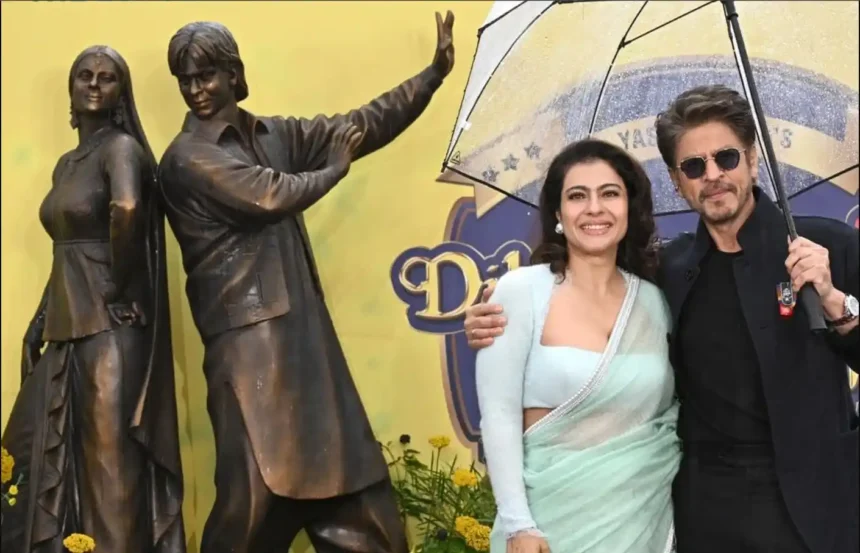
The film’s iconic characters, Raj and Simran, were immortalised in bronze at Leicester Square as part of London’s Scenes in the Square trail. The statues were unveiled in 2021, giving one of Indian cinema’s most recognisable romances a permanent place alongside celebrated characters and moments from international film history.
For fans, the significance goes far beyond a statue.
It is a recognition of the extraordinary cultural footprint of a Hindi film whose story travelled far beyond India.
Raj and Simran Find a Permanent Place in London
The Raj and Simran sculptures recreate one of the visual identities most closely associated with Dilwale Dulhania Le Jayenge.
The figures capture Raj in his familiar open-armed pose, while Simran stands nearby, recreating the spirit of the romance that audiences have associated with the characters for generations.
The choice of Leicester Square is particularly meaningful.
Located in the heart of London’s West End, Leicester Square has long been connected with cinema, premieres and entertainment. The Scenes in the Square trail celebrates memorable characters and cinematic moments from film history, turning the area into an open-air tribute to the movies.
For DDLJ to enter that space represented a significant moment for Indian popular cinema.
It also reflected the film’s international identity. London was not simply a backdrop in Raj and Simran’s story. It was part of the emotional geography of the film.
Why London Matters to DDLJ
From its opening moments, DDLJ connected Indian romance with a European setting.
The story moved between London, Switzerland and India, creating a world in which traditional family expectations and modern ideas of love could exist side by side.
Raj and Simran’s journey was ultimately rooted in India, but their relationship began against a distinctly international backdrop.
That combination became one of the film’s defining strengths.
Raj was an Indian living abroad, while Simran was raised in a traditional Punjabi family in London. Their European journey brought them together, but the story repeatedly returned to questions of family, identity, tradition and belonging.
The film therefore became more than a conventional romantic comedy.
It reflected the experiences of an increasingly global Indian audience while retaining a strong emotional connection to Indian family values.
Shah Rukh Khan and Kajol: A Pair That Became Cinema History
Much of DDLJ‘s enduring appeal rests on the chemistry between Shah Rukh Khan and Kajol.
As Raj and Simran, the two actors created a dynamic that combined humour, romance, vulnerability and emotional intensity.
Raj’s playful confidence contrasted with Simran’s initial uncertainty, allowing their relationship to develop gradually rather than through a conventional instant-romance formula.
The performances also helped establish Shah Rukh Khan’s image as one of Bollywood’s defining romantic heroes.
His Raj was mischievous without becoming careless, confident without losing vulnerability and rebellious while ultimately respecting Simran’s family.
Kajol’s Simran was equally important to the film’s identity. She was romantic and imaginative but also deeply connected to her family and upbringing.
That balance helped make the characters relatable to audiences across generations.
The London Reunion Carries a Different Kind of Nostalgia
Whenever Shah Rukh Khan and Kajol appear together, DDLJ inevitably becomes part of the conversation.
Their association with Raj and Simran is so deeply embedded in Bollywood culture that even a contemporary appearance can trigger memories of the 1995 classic.
The London setting makes that nostalgia even stronger.
The city featured prominently in the film’s narrative, and seeing the actors associated with Raj and Simran in London creates a striking connection between the fictional world of DDLJ and the real locations that helped define it.
It is a reminder that some movie characters eventually become larger than the films that introduced them.
Raj and Simran are now cultural references in their own right.
Shah Rukh Khan Keeps It Classic in Black
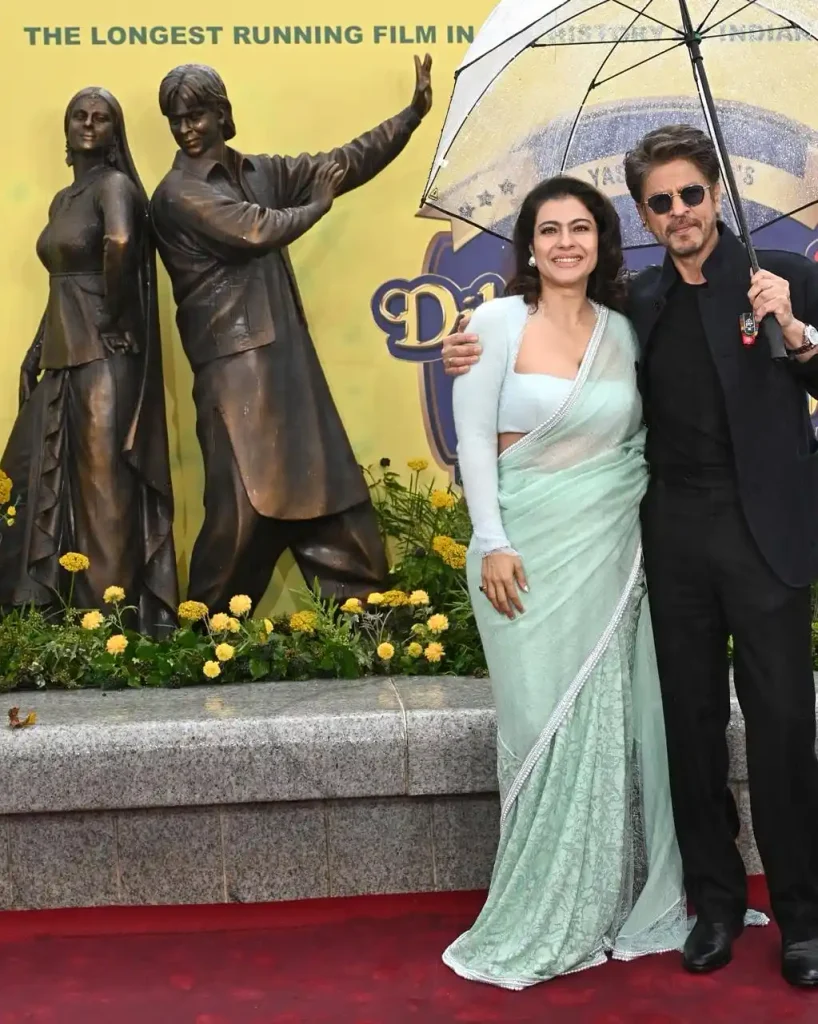
At the London appearance, Shah Rukh Khan’s styling reflected the same understated confidence that has become a familiar part of his public fashion identity.
The actor opted for a sophisticated all-black ensemble, built around a structured bandhgala-style jacket, a black crew-neck layer and sharply tailored trousers.
The monochromatic palette gave the outfit a polished, contemporary character without competing with the occasion.
Tinted aviator sunglasses added a touch of attitude, while a subtle lapel detail provided a restrained finishing touch.
The styling was particularly effective because it did not attempt to recreate Raj’s 1990s wardrobe.
Instead, Khan appeared as himself—a contemporary superstar standing beside the characters that helped define his career.
That distinction makes the moment more interesting from a fashion perspective.
Kajol Brings Soft Elegance to the Occasion
Kajol complemented the formal setting with a graceful pastel ensemble.
Her soft mint-green saree created a lighter visual contrast against Khan’s black outfit. The delicate fabric and tonal detailing gave the look a romantic quality that felt appropriate for an occasion celebrating one of Bollywood’s most famous love stories.
The saree’s intricate lace-inspired detailing and subtle border work added texture without overwhelming the pastel palette.
A structured blouse provided definition to the otherwise flowing silhouette, while understated jewellery kept the overall appearance elegant.
Her beauty styling remained equally polished, with luminous makeup, soft-toned lips and voluminous waves framing the face.
The overall effect was classic rather than trend-driven.
That worked particularly well for an event built around nostalgia and cinematic heritage.
Three Decades of DDLJ: Why the Film Still Matters
When Dilwale Dulhania Le Jayenge arrived in cinemas in 1995, few could have predicted the scale of its eventual legacy.
The film became one of Hindi cinema’s defining romantic successes and developed an extraordinary relationship with audiences over the years.
Its songs became cultural staples. Its dialogues entered everyday popular culture. Its characters became shorthand for a particular kind of Bollywood romance.
Most importantly, the film remained connected to audiences beyond its original theatrical era.
The story’s central conflict—love versus family expectations—continues to have emotional relevance, even as social attitudes and relationships have changed.
The film also presented a version of the Indian diaspora that resonated with audiences familiar with life between cultures.
Raj and Simran were not simply two young people falling in love.
They represented a generation navigating the space between tradition and modernity.
From the Mustard Fields to Leicester Square
Few Bollywood films have created such a recognisable visual journey.
The story moved from European streets and train stations to the landscapes of India, culminating in the emotional return that became one of the film’s most memorable sequences.
The famous mustard-field imagery, the European train journey and Raj’s open-arms pose all became part of the film’s visual vocabulary.
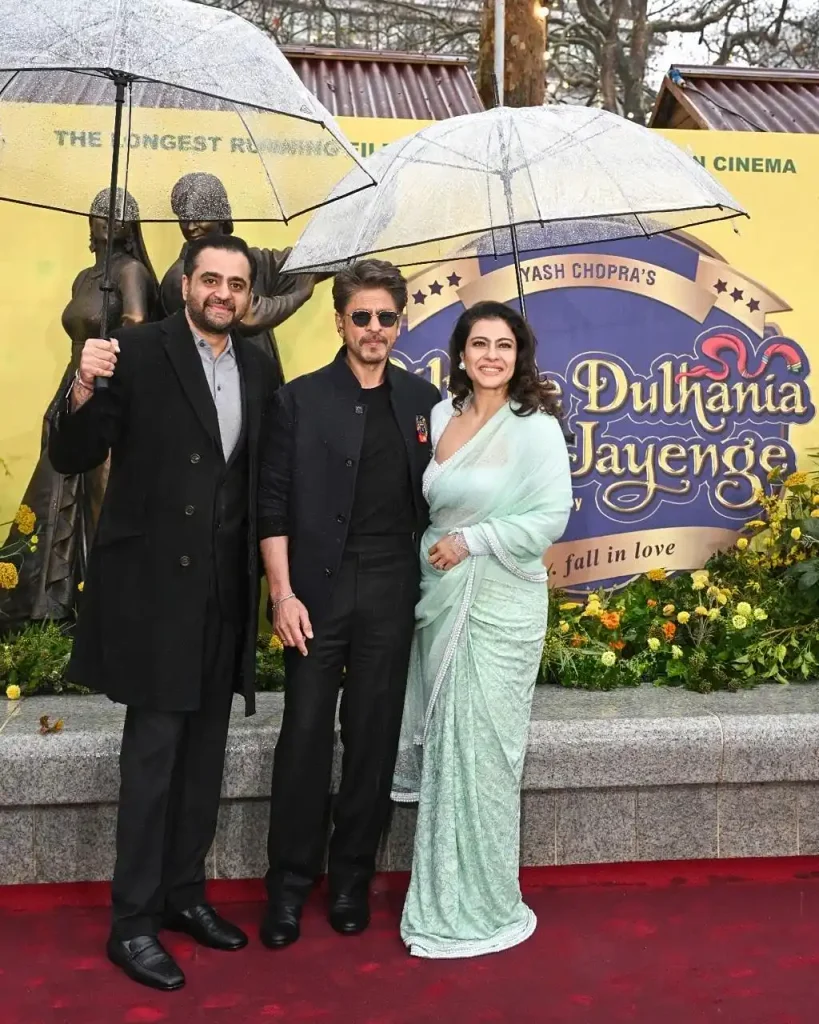
Placing Raj and Simran in bronze in central London adds another chapter to that journey.
The characters began as fictional creations on a cinema screen. They later became symbols of Bollywood romance and are now represented physically in a major international film destination.
That progression says something about the cultural reach of Indian cinema.
More Than a Statue
A bronze sculpture may appear to be a simple tribute, but in the case of DDLJ, it represents something considerably larger.
It acknowledges the influence of Indian cinema on international audiences and recognises a film whose appeal crossed geographic and cultural boundaries.
For Indian audiences visiting London, the Raj and Simran statues provide a tangible connection to a beloved piece of cinematic history.
For international film fans, they offer another entry point into the world of Bollywood.
And for generations who watched DDLJ during its original release, the statues provide a powerful reminder of how deeply the film became embedded in popular culture.
The Enduring Chemistry of SRK and Kajol
The Shah Rukh Khan-Kajol pairing has been revisited in several films over the years, but DDLJ remains the definitive chapter in their shared cinematic history.
The chemistry they created as Raj and Simran was never based solely on romance.
It came from the contrast between their personalities, their comic timing and the emotional credibility they brought to the characters.
That is why the pairing continues to work decades later.
Even when Khan and Kajol appear together outside the original film, audiences instinctively recognise echoes of Raj and Simran.
The association has become part of Bollywood’s collective memory.
A Legacy That Continues to Travel
Thirty years after its release, Dilwale Dulhania Le Jayenge remains a remarkable example of cinematic longevity.
Its continued relevance is not simply a result of nostalgia.
The film successfully combined romance, humour, music, family drama, diaspora identity and Indian cultural values into a story that remained accessible to audiences around the world.
The Raj and Simran statues in Leicester Square provide a fitting physical representation of that international legacy.
London was part of their fictional journey.
Decades later, it became the place where their cinematic identities were permanently celebrated.
And that may be the most fitting tribute of all.
Because DDLJ was always a story about journeys—across countries, across generations and ultimately across cultures.
Raj and Simran may have started their love story on a European train, but their journey has travelled much farther.
It has reached millions of viewers, inspired generations of Bollywood fans and secured a permanent place in the cultural landscape of London.
ALSO READ:
- Rashmika Mandanna’s Elegant Ethnic Looks Offer the Perfect Inspiration for the Festive Season
- Ridhi Garg’s ‘Husn-e-Jahan’ Reimagines Festive Fashion Through Nature, Art and Indian Craftsmanship
- Kiara Advani and Sidharth Malhotra’s Love Story: From a Private Romance to a Beautiful Family Journey
- Triptii Dimri Blends Modern Glamour with Timeless Elegance in Her Latest Promotional Fashion Diary
- Kiara Advani Brings Contemporary Royalty to the NMACC 3rd Anniversary Gala in a Custom House of Masaba Saree
- Girija Oak Godbole Celebrates Maharashtra’s Textile Heritage in a Contemporary Tissue-Striped Paithani
- Girija Oak Godbole Brings a Contemporary Edge to the Timeless Paithani Saree
- ‘Quiet Confidence Never Goes Out of Style’: Minimalist Fashion Editorial Wins Hearts Online
- Sobhita Dhulipala Brings Rahul Mishra’s ‘Devi: The Eternal Muse’ to Life at India Couture Week 2026
- Manya Singh Shares Update After Being Stranded in Dubai Amid Regional Flight Disruptions
- Akanksha Choudhary Alleges She Faced Sexual Misconduct While Pursuing a Beauty Pageant Opportunity
- Ananya Panday Celebrates Friendship Day with Her Furry Companions, Wins Hearts with Adorable Instagram Post