



Indian festive fashion has traditionally embraced abundance — intricate embroidery, lustrous fabrics, dramatic silhouettes and layers of embellishment. But as the new festive season approaches, a more restrained approach to occasion dressing is emerging, with designers increasingly allowing the character of the textile itself to take centre stage.
Designer Vaishali S is exploring that philosophy in her latest collection, turning the inherent beauty and complexity of Indian handwoven fabrics into a key element of the design language.
For Vaishali, luxury is not necessarily defined by the amount of decoration placed on a garment. Instead, she sees it in the depth of the textile, the craftsmanship behind it and the emotion created through construction.
“For me, luxury has never been about how much you can add to a garment. It is about how much depth, emotion, and craftsmanship you can create within it.”
Letting the Weave Become the Embellishment
India’s handloom tradition offers an extensive range of textures and techniques, and Vaishali is particularly interested in the visual and tactile qualities found in fabrics such as chanderi, khun, jamdani and maheshwari.
See more of our coverage in your search results.
Add Hunterfly on GoogleAccording to the designer, these textiles already contain layers of detail within their construction. The movement of the threads, variations created by hand weaving and the distinctive structure of each fabric can provide a form of ornamentation without relying heavily on additional embellishment.
She believes that excessive decoration can sometimes obscure these qualities rather than enhance them.
This idea has led her to investigate ways of transforming fabric itself into the decorative element of a garment.
From Two-Dimensional Fabric to Sculptural Fashion
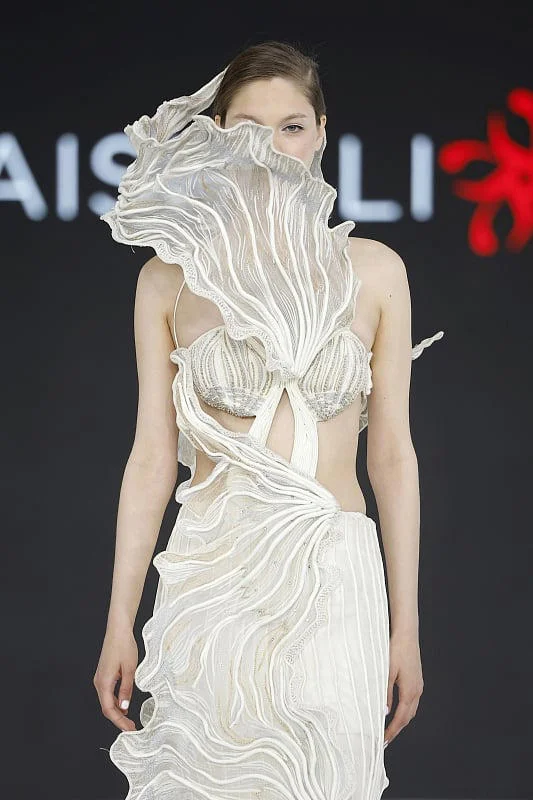
Vaishali’s approach involves techniques such as cording, pleating, knotting, draping and sculpting. Through these interventions, traditionally flat textiles can acquire volume, movement and a more architectural character.
The result is an exploration of fashion that operates beyond a conventional two-dimensional surface. Instead of simply adding embellishments to a fabric, the construction itself creates visual interest through form, light and shadow.
See more of our coverage in your search results.
Add Hunterfly on GoogleLight becomes part of the design, while shadows generated by folds, cords and sculpted surfaces can function almost like embroidery.
Discovering the Silhouette Within the Textile
One of the most distinctive aspects of Vaishali’s design philosophy is her approach to choosing fabrics. Rather than deciding on a silhouette first and then selecting a textile to execute it, she allows the characteristics of the weave to influence the eventual form.
“I don’t begin with a formula. I begin by listening to the textile,” she explains.
See more of our coverage in your search results.
Add Hunterfly on GoogleFor the designer, every handwoven fabric has a distinct personality. Factors including weight, transparency, stiffness, density, drape and the natural irregularities of handloom production can determine how a material should be handled.
This makes the textile an active part of the design process rather than simply a surface for a predetermined garment.
Why Chanderi Works for Sculptural Experimentation
Vaishali particularly highlights chanderi as a textile that offers interesting possibilities for her construction techniques.
Its delicate and translucent appearance can coexist with structural interventions such as cording, allowing the fabric to acquire a sculptural dimension while retaining some of its inherent lightness.
Other handwoven textiles may naturally lend themselves to fluid draping rather than architectural shaping. In those cases, Vaishali allows the material to retain its movement and fall around the body.
Her process, therefore, is less about imposing a fixed structure and more about responding to what each textile naturally offers.
Pushing Handwoven Textiles Further
For her upcoming collection, Vaishali says she is continuing her work with handwoven textiles and her signature cording technique, while looking for new possibilities in garment construction.
The challenge is to make the construction more experimental without sacrificing a feeling of lightness.
Another important direction is the designer’s interest in taking traditional Indian textile knowledge into a contemporary global context. Rather than treating handwoven fabrics as elements confined to conventional Indian occasionwear, she is exploring how their techniques and visual language can translate into more internationally oriented silhouettes.
The collection consequently sits at the intersection of Indian textile heritage, contemporary construction and sculptural fashion.
A Quieter Definition of Festive Luxury
Vaishali S’s latest exploration reflects a broader possibility for Indian occasionwear: that visual richness does not always have to come from more embroidery, more shine or more ornamentation.
A handwoven textile can carry its own complexity. Through considered construction, draping and sculpting, that complexity can become the primary design statement.
For Vaishali, the process begins by understanding the material itself. Instead of forcing a fabric into a predetermined idea, she seeks to uncover the form already suggested by its weave, movement and texture — allowing India’s textile traditions to become the foundation for a contemporary fashion vocabulary.