







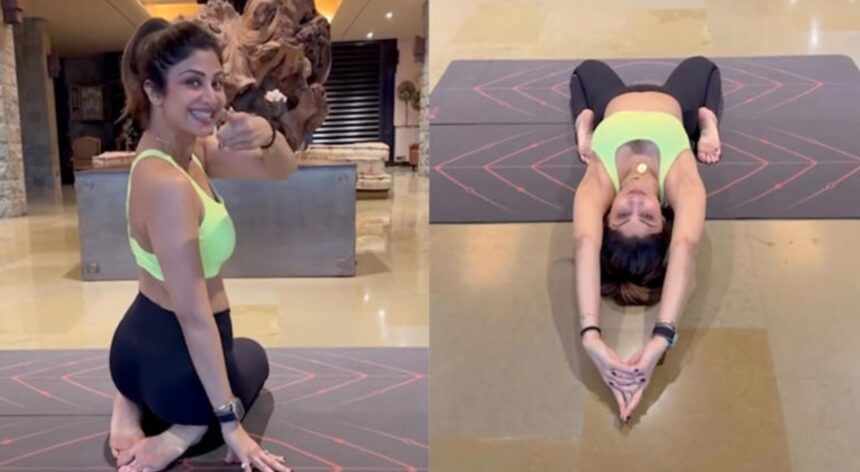
Shilpa Shetty has shared a glimpse of her yoga routine with a video featuring Supta Vajrasana, or Reclining Thunderbolt Pose. Calling it “a slow stretch with benefits that go deeper,” the actor also highlighted the importance of patience, breathing and consistency in yoga practice.
Shilpa Shetty has once again turned attention towards yoga with a video demonstrating Supta Vajrasana, a reclining variation of Vajrasana.
The actor’s latest post focuses less on speed and more on controlled movement. In the video, she begins in Vajrasana before gradually leaning backwards, using her arms for support and eventually lowering her upper body until her head reaches the floor.
Once in the position, Shilpa maintains the posture while breathing steadily for several moments.
See more of our coverage in your search results.
Add Hunterfly on GoogleShilpa Shetty Explains Supta Vajrasana
Alongside the video, Shilpa described Supta Vajrasana as a slow movement with benefits that extend beyond a simple stretch.
“Benefits: Supta Vajrasana (Reclining Thunderbolt Pose) deeply stretches the front body while improving digestion and increasing flexibility in the spine, knees, and ankles,” she wrote.
She also highlighted the muscles involved in the posture.
“The pose stretches the quadriceps, hip flexors, and psoas muscles, helping release tension through the lower body. It also expands the ribcage and improves lung capacity, supporting deeper and more comfortable breathing,” Shilpa added.
The actor also included a precaution for people attempting the pose, noting that those experiencing knee or ankle pain should avoid practising Supta Vajrasana.
See more of our coverage in your search results.
Add Hunterfly on GoogleAs with any demanding yoga posture, proper technique and individual physical limitations are important to consider, particularly because the pose places substantial demands on the knees, ankles and lower body.
Shilpa Shetty Says Yoga Changed More Than Her Fitness
Shilpa has spoken about her relationship with yoga on several occasions, explaining that her reasons for practising it have changed over the years.
In a previous interview with YourStory, she recalled initially turning to yoga to address a cervical injury.
See more of our coverage in your search results.
Add Hunterfly on Google“First, I did yoga to alleviate my cervical injury. Then, for the next four years, I did yoga to stay fit. But that’s how you look at yoga when you’re young,” she said.
Her perspective gradually evolved beyond physical fitness.
“Today, yoga has changed me, and it has changed the way I think. Today, it’s about being aligned. I don’t look at it as an exercise regime,” Shilpa explained.
Instead, she described yoga as a way of maintaining balance and feeling connected with herself.
“I look at it as a way to keep myself balanced and to keep myself in sync with my soul,” she added.
Why Shilpa Believes Consistency Matters
For Shilpa, yoga is not about mastering a posture immediately. She has often described the practice as a gradual process in which regularity allows people to understand their bodies and improve their technique over time.
A movement that appears simple at first can become more challenging as practitioners explore control, flexibility, breathing and alignment.
That philosophy is reflected in her latest Supta Vajrasana video, where the emphasis is on moving slowly and maintaining control rather than rushing through the posture.
Yoga as a Long-Term Practice
Shilpa’s approach to yoga has evolved from using it as part of physical conditioning to viewing it as a broader practice of self-awareness.
For her, maintaining a regular yoga routine is connected with confidence, balance and personal growth.