






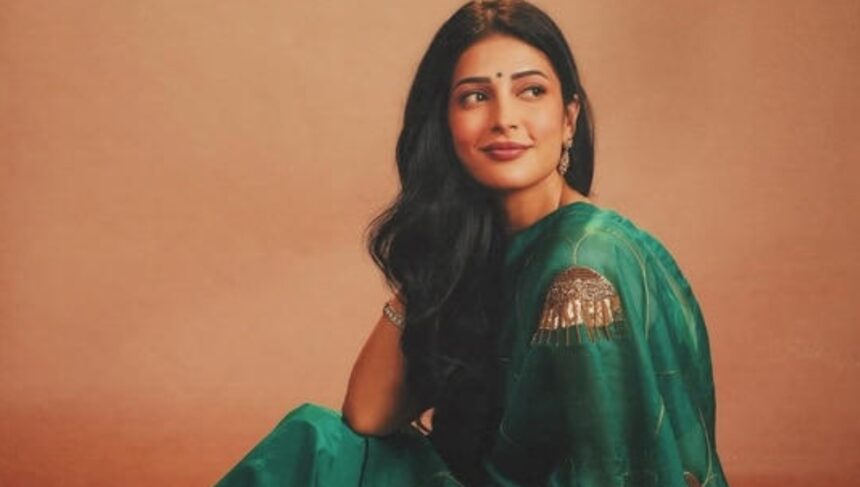
Shruti Haasan has opened up about her thoughts on motherhood and her long-standing experience with polycystic ovary syndrome (PCOS). The actor, who turned 40 in January, said she hopes to become a mother someday and recalled being told from a young age that conceiving could be difficult because of her condition.
Speaking on Soha Ali Khan’s podcast, Shruti said she was diagnosed with PCOS-related concerns when she was around 14. The repeated warnings about fertility left her with the impression that pregnancy might not be an option for her.
However, she said a supportive gynaecologist, Dr Dhrupti Dedhia, helped her look at the situation differently and gave her a more hopeful perspective.
Shruti Haasan Says She Was Warned About Conception Since She Was 14
Discussing her experience with PCOS, Shruti recalled being told that conception could be difficult.
See more of our coverage in your search results.
Add Hunterfly on Google“I’ve been told throughout that PCOS and childbirth, like conception, is like forget about it. Since I was fourteen, it’s going to be difficult, amma,” she said.
The actor explained that the comments affected the way she viewed motherhood for years. At one point, she had even considered adoption as a possible path to becoming a parent.
Her perspective changed after speaking with Dr Dhrupti Dedhia, whom she described as being supportive and reassuring about her options.
“But she really broke it down to why it’s not. She just opened my mind,” Shruti said.
Her Gynaecologist Changed the Way She Viewed Motherhood
According to Shruti, her doctor did not treat motherhood as something that was automatically ruled out because of PCOS.
See more of our coverage in your search results.
Add Hunterfly on Google“She just opened my mind. It was about saying, in a really beautiful way, if that’s what you want, when you’re ready, we’ll figure it out,” she recalled.
That approach appears to have helped Shruti move away from the idea that her PCOS diagnosis had already determined her future fertility.
The actor also pointed to Cameron Diaz as an example that gave her additional hope. Diaz welcomed her first child at 47 and announced the birth of her second child in 2024 at the age of 51. Shruti referenced Diaz becoming a mother later in life while discussing her own hopes for the future.
See more of our coverage in your search results.
Add Hunterfly on Google“Now you see that Cameron Diaz had a baby at 53. I’m so glad that my doctor speaks to me that way,” Shruti said.
Can PCOS Make It Harder to Conceive?
PCOS is a common hormonal and metabolic condition that can affect ovulation. While it can make conception more difficult for some women, a PCOS diagnosis does not by itself mean that pregnancy is impossible.
Infertility and IVF specialist Dr Richika Sahay Shukla recently explained the connection between PCOS and ovulation to HT Lifestyle.
“In a normal month, one follicle grows, matures and releases an egg. In PCOS, many follicles start growing, but none take the lead,” she explained.
When ovulation occurs less frequently, the number of opportunities to conceive can also be reduced. A person with a regular 28-day menstrual cycle may ovulate around 12 or 13 times in a year. Someone whose cycles are much longer, such as 60 or 90 days, may ovulate only around four or five times a year.
However, fertility varies considerably from person to person. PCOS can affect ovulation and conception, but individual fertility outcomes depend on multiple factors.
Shruti Haasan Wants to Keep Motherhood Open as a Possibility
Shruti’s comments reflect a broader shift in how she thinks about motherhood. Rather than viewing her PCOS diagnosis as an automatic barrier, she now says she wants to approach the possibility with an open mind and with appropriate medical guidance when she is ready.
Her experience also highlights the importance of receiving personalised information from qualified healthcare professionals rather than assuming that a diagnosis alone determines fertility.
For now, Shruti says motherhood is something she would like to experience someday. Her conversation with Soha Ali Khan offered a candid look at how an early warning about PCOS shaped her thinking — and how a reassuring medical perspective helped her reconsider what might be possible.