



What happens when a chocolate bar becomes a temple offering? At a temple in Kerala, devotees have reportedly been offering Munch chocolates to Lord Murugan, and the same chocolates are then returned to them as prasad.
The unusual tradition has recently attracted widespread attention online after a video showcasing the practice went viral on social media.
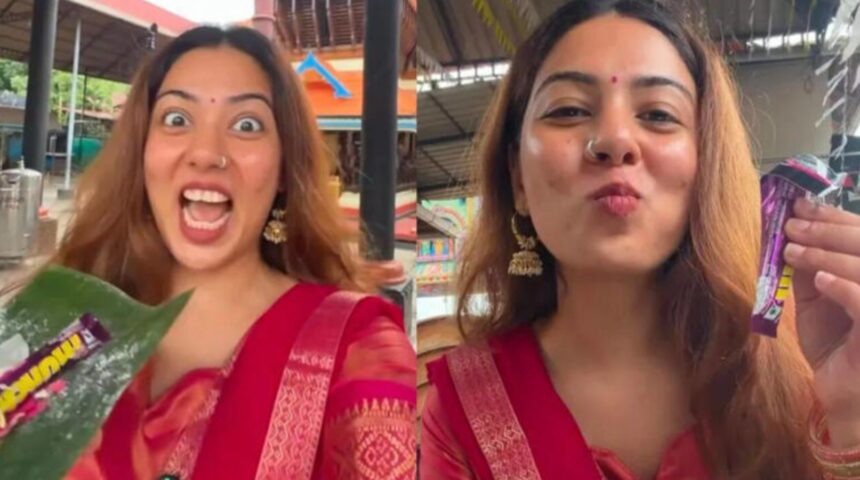
The temple at the centre of the conversation is Thekkan Pazhani Sree Subramanya Swami Maha Kshetram Thalavadi Temple, located in Kerala’s Alappuzha (Alleppey) region. A video shared by content creator Reha Adani showed the temple and highlighted its distinctive offering.
The clip immediately caught viewers off guard because the prasad associated with the temple includes something far more familiar from a supermarket shelf than a conventional temple offering.
See more of our coverage in your search results.
Add Hunterfly on Google“This looks like any other temple, until you enter and get Munch as the prasad,” Adani wrote while sharing her experience.
The video has since encouraged social media users to discuss the temple, its traditions and the story popularly associated with the chocolate offering.
Why Is Munch Offered at This Kerala Temple?
According to accounts circulating online, devotees have been offering Munch bars to Lord Murugan at the temple for several years.
The chocolate is subsequently given back to devotees as prasadam, alongside more familiar religious offerings such as flowers and sandal paste.
The practice is unusual, but it is also a reminder that religious traditions can develop in highly local and distinctive ways.
See more of our coverage in your search results.
Add Hunterfly on GoogleTemple offerings across India vary significantly from one shrine to another. While fruits, sweets, flowers and other traditional items are common, individual temples can develop their own customs based on local beliefs, devotional practices and community traditions.
At the Thalavadi temple, the Munch offering has become particularly memorable because of its association with Lord Murugan.
The practice has also reportedly led to the informal nickname “Munch Murugan” being used by some people online.
See more of our coverage in your search results.
Add Hunterfly on GoogleHowever, it is important to distinguish between the popular name circulating on social media and the temple’s formal religious identity.
The Story Behind ‘Munch Murugan’
One of the most widely circulated explanations for the tradition involves a child who was reportedly unwell.
According to the version shared in the viral video, the child offered a Munch chocolate to Lord Murugan and later recovered.
The story is presented as the beginning of a tradition that continued among devotees.
Over time, the unusual offering reportedly became associated with the deity, eventually contributing to the informal term “Munch Murugan”.
There is, however, an important caveat.
The Origin Story Has Not Been Definitively Established
The precise history of the chocolate offering remains unclear.
Different versions of the story have circulated online, and the account involving the sick child is one of the explanations being shared by visitors and social media users.
But the available information does not establish that this is the officially documented origin of the practice.
Reports indicate that temple authorities have not confirmed a definitive historical account explaining exactly how the Munch offering began.
That distinction matters.
Rather than presenting the child-related story as an established historical fact, it is more accurate to describe it as a popular local or social-media account associated with the tradition.
What Do Devotees Receive as Prasad?
The most talked-about element is, naturally, the chocolate.
Devotees reportedly offer Munch bars to the deity, after which the chocolates are returned as prasadam.
Traditional offerings such as flowers and sandal paste are also associated with the temple.
The practice has therefore become a distinctive feature of the visitor experience.
For devotees, the significance is not necessarily the commercial value of the chocolate itself. The act of offering something to a deity and receiving it back as prasadam is part of a devotional practice.
The unusual nature of the item is what makes the tradition particularly interesting to outsiders.
Why the Viral Video Has Captured Attention
The social media reaction has been driven largely by the surprise factor.
Most people encountering the video expected to see a conventional temple visit. Instead, they discovered a shrine where a familiar chocolate bar forms part of the offering tradition.
That contrast made the video highly shareable.
The clip also benefited from a simple premise: a temple where you can receive Munch as prasad.
It is the kind of unexpected cultural detail that naturally encourages viewers to tag friends, share personal experiences and ask questions about the location.
The comments quickly became a mixture of humour, curiosity and genuine interest.
Visitors Say They Have Been to the Temple
Several people responding to the video claimed that they had personally visited the temple.
One commenter wrote:
“I visited this temple. So beautiful, and yeah, the Munch was extra crunchy. Don’t know why.”
Another said:
“I visit here every week. I live near the temple.”
Such comments added another layer to the online conversation because they suggested that the tradition is not simply a social-media invention.
At the same time, individual comments cannot independently establish the complete history or religious significance of the practice. They are best understood as personal accounts from social media users.
Chocolate Lovers Had Their Own Reaction
Predictably, the unusual prasadam also attracted comments from people who simply love Munch.
One user joked about how a Munch fan might feel after receiving the chocolate as temple prasad.
Others described the practice as adorable and expressed curiosity about visiting the temple themselves.
The conversation demonstrates how social media can turn a small local tradition into a subject of national curiosity.
Something that may be familiar to people living near the temple can seem completely new to viewers elsewhere in India.
‘Coincidence or a Sign?’
Among the more unusual comments was one from a viewer who connected the video with a personal dream.
The user wrote:
“Dreamt of getting a Munch as prasad a year ago… now I’ve found the temple. Coincidence or a sign?”
The comment received attention because it transformed an otherwise amusing viral trend into a personal spiritual coincidence.
Such reactions are common when unusual religious traditions become visible online. Viewers naturally interpret them through their own experiences, beliefs and memories.
However, whether such coincidences have spiritual significance is ultimately a personal matter rather than something that can be objectively established.
A Local Tradition Becomes an Internet Phenomenon
The story of the Thalavadi temple illustrates how social media has changed the way people discover India’s lesser-known cultural practices.
In the past, a distinctive tradition at a local temple might have remained familiar primarily to residents and regular devotees.
A single well-shot video can now introduce that tradition to millions of people.
The process can work particularly well when the subject contains an unexpected element.
In this case, the combination of Lord Murugan, a Kerala temple and Munch chocolate prasad provided exactly that.
The phrase “Munch Murugan” itself became an effective shorthand for the tradition, making the story even easier to remember and share.
Why Temple Traditions Can Be So Diverse
India’s religious landscape contains an enormous range of local customs.
Different temples may have distinctive offerings, festivals, rituals, architectural features or devotional practices shaped by regional history and community traditions.
Not every custom has a single documented origin.
Some develop gradually through repeated community practice, while others are linked to local stories, legends or experiences attributed to devotees.
The Munch tradition at the Thalavadi temple appears to have generated precisely this kind of local identity.
Its unusual nature does not necessarily make it less meaningful to devotees. Instead, it illustrates how religious practice can incorporate culturally familiar objects into a devotional setting.
Is the Temple Really Called ‘Munch Murugan Temple’?
Not officially, based on the information currently available.
The temple’s name is Thekkan Pazhani Sree Subramanya Swami Maha Kshetram Thalavadi Temple.
“Munch Murugan” is an informal expression that has gained visibility through social media and discussions surrounding the chocolate offering.
This distinction is worth noting because viral posts can sometimes simplify or rename places in ways that are catchy but not formally recognised.
Anyone planning a visit should therefore search for the temple’s proper name and verify current location and visiting information rather than relying only on the viral nickname.
What Makes the Tradition Different?
The Munch offering stands out for three main reasons.
1. The offering is instantly recognisable
Unlike many traditional religious offerings, Munch is a packaged commercial chocolate familiar to a large number of Indian consumers.
2. The offering is returned as prasad
The chocolate reportedly becomes part of the prasadam received by devotees, creating a memorable connection between the offering and the visitor experience.
3. Its origin story remains part of local lore
The popular story involving a child and a recovery has helped explain why the tradition exists, but its precise historical status remains uncertain.
These three elements have made the temple particularly attractive to social media audiences.
More Than Just a Viral Chocolate Story
It would be easy to treat the temple entirely as an internet curiosity.
But for devotees, the significance is likely much deeper than the novelty of receiving a chocolate bar.
A temple tradition is ultimately connected to faith and community. The unusual nature of an offering may attract visitors, but the meaning attached to that offering comes from the devotees who participate in the practice.
The viral attention could therefore introduce new visitors to a local place of worship while also encouraging wider interest in Kerala’s diverse religious traditions.
At the same time, visitors should approach the temple respectfully and avoid treating devotional practices purely as entertainment content.
What We Know About the ‘Munch Murugan’ Tradition
To separate the verified details from the stories circulating online:
- The temple is Thekkan Pazhani Sree Subramanya Swami Maha Kshetram Thalavadi Temple in Kerala.
- It is dedicated to Lord Subramanya/Murugan.
- A viral video recently highlighted its unusual chocolate offering.
- Devotees are reported to offer Munch chocolates to the deity.
- The chocolate is reportedly returned to devotees as prasadam.
- Flowers and sandal paste are also associated with the offerings.
- “Munch Murugan” is an informal nickname that has circulated online.
- A story involving a child who reportedly recovered after offering Munch is widely shared as an explanation for the custom.
- The exact historical origin of the tradition has not been definitively established from the information available.
- Social media users have shared both humorous reactions and personal accounts of visiting the temple.
Final Take
The Thekkan Pazhani Sree Subramanya Swami Maha Kshetram Thalavadi Temple has captured the internet’s imagination for a remarkably simple reason: devotees reportedly offer Munch chocolates to Lord Murugan and receive them back as prasad.
The practice has now become widely discussed after a viral video introduced the temple to a much larger audience.
The popular “Munch Murugan” story adds another layer of intrigue, although the precise origin of the tradition remains uncertain and should not be presented as established fact without confirmation from the temple.
Ultimately, the viral moment offers more than an amusing chocolate story. It provides a glimpse into the extraordinary variety of local traditions that exist across India’s temples—and how quickly a small, distinctive custom can travel far beyond its original community once social media discovers it.