






Kalpana Jha and Uma Jha began with traditional Mithila pickle-making skills in Darbhanga, faced disappointment after leaving Shark Tank India without a deal, and later saw their entrepreneurial journey take an unexpected turn.
When Kalpana Jha and Uma Jha walked into the Shark Tank India studio for the first season of the show, they carried more than jars of traditional pickles.
The sisters-in-law from Darbhanga, Bihar, were representing a business built around family recipes, regional food traditions and a desire to create meaningful employment in their community.
Their company, JhaJi Store, had begun with a relatively simple idea: turn their experience of making traditional pickles and chutneys into a modern consumer brand.
Their appearance on Shark Tank India soon made them familiar faces to audiences across the country.
See more of our coverage in your search results.
Add Hunterfly on GoogleAlthough their first pitch did not result in an investment from the Sharks, the story did not end there. The exposure helped bring JhaJi Store to the attention of a much wider audience, while the founders continued working to grow the business.
Later, according to the founders’ account and previously reported information, Sharks Vineeta Singh and Namita Thapar visited the company’s operations in Darbhanga and presented the founders with an investment cheque of Rs 85 lakh.
For Kalpana and Uma, the journey became a story of persistence, regional entrepreneurship and the ability to keep moving forward even after an initial setback.
The Beginning of JhaJi Store
The roots of JhaJi Store can be traced back to 2020, when the COVID-19 pandemic changed everyday life across India.
Like millions of others, Kalpana and Uma found themselves reassessing the future and considering new opportunities.
See more of our coverage in your search results.
Add Hunterfly on GoogleThey had long shared an interest in traditional pickle-making and decided to explore whether this passion could become a business.
The process did not begin overnight.
The founders had to work through the practical requirements involved in starting a food business, including licences and other operational formalities.
See more of our coverage in your search results.
Add Hunterfly on GoogleAccording to Kalpana, the initial range included a limited number of pickle varieties.
Like many first-time entrepreneurs, the founders also faced uncertainty.
One of their biggest questions was simple: would customers outside their immediate circle enjoy the taste of their products?
Traditional recipes can be deeply personal. What one family considers authentic may differ from the preferences of consumers in another part of the country.
Still, Kalpana and Uma decided to take the risk.
JhaJi Store was eventually launched online in 2021, bringing traditional Mithila-inspired pickles and chutneys to customers through a modern direct-to-consumer approach.
Turning a Passion Into a Profession
For the two founders, starting the company was also about creating an independent identity as entrepreneurs.
They had always wanted to do something of their own and saw their knowledge of traditional recipes as a potential starting point.
Instead of allowing those skills to remain limited to the family kitchen, they began exploring how to build a commercial venture around them.
The business also developed during a period of significant economic disruption.
The pandemic affected employment across India, particularly for families dependent on informal or temporary work.
According to the founders, JhaJi Store created work opportunities for women and other people in their local community during its early stages.
They said some families had been facing economic difficulties during the pandemic, and the growing business created a possibility for local employment.
This social dimension became an important part of the JhaJi Store story.
The company was not only about taking Mithila’s flavours to a wider market. It was also about creating opportunities in the founders’ hometown of Darbhanga.
The Shark Tank India Opportunity
Within months of starting the business, Kalpana and Uma received an opportunity that would dramatically increase public awareness of their brand.
They were selected to participate in Shark Tank India.
The journey to the television show reportedly involved auditions in multiple cities before the founders finally made it to the set.
For two first-time entrepreneurs from Darbhanga, appearing before some of India’s best-known business personalities was a major milestone.
Their pitch was built around traditional pickles and chutneys, but the founders also demonstrated an understanding of their business and its growth potential.
The Sharks appreciated their products and their entrepreneurial spirit.
However, the pitch did not end with an investment deal.
Kalpana and Uma returned home without funding.
The Disappointment of Leaving Without a Deal
Not receiving an investment was disappointing for the founders.
They had entered the show with ambitions for their business and with the expectations of the people working alongside them.
According to Kalpana, the women associated with the company had also placed their hopes in the founders’ appearance on the national platform.
After returning home without a deal, the founders faced an important question: how would they secure the resources needed to expand?
For many entrepreneurs, a rejection can become a defining moment.
It can lead to a change in strategy, a loss of confidence or, in some cases, a renewed determination to prove that the original idea can work.
Kalpana and Uma chose the third path.
They returned to Darbhanga and went back to work.
Instead of allowing the outcome of the television pitch to define the future of JhaJi Store, they focused on building the company.
Shark Tank Exposure Brings National Attention
While JhaJi Store did not receive a deal during its initial appearance, the national exposure had another important effect.
People across India had now seen the founders and heard their story.
As has happened with several businesses featured on Shark Tank India, the programme helped introduce the brand to a wider consumer audience.
The founders continued to work on expanding their operations while dealing with growing interest in the company.
Kalpana later spoke about receiving attention from potential investors and others interested in supporting the business.
The experience highlighted an important reality for entrepreneurs appearing on Shark Tank India: a deal is not the only possible outcome.
National visibility can itself become a powerful business opportunity.
For JhaJi Store, the appearance helped bring the brand and the culinary traditions of Mithila into conversations far beyond Bihar.
An Unexpected Visit to Darbhanga
The JhaJi Store story later took a surprising turn.
According to the founders, they did not expect the Sharks who had seen their original pitch to visit their factory.
But during the mango season, the JhaJi Store team reportedly received a major surprise.
Vineeta Singh and Namita Thapar arrived in Darbhanga along with the show’s team.
For Kalpana and Uma, the visit was more than a casual meeting.
The Sharks reportedly spent several hours observing the business and its processes, from the preparation of ingredients to packaging.
The visit gave them a closer look at the company’s operations and the people behind the products.
For the founders, it was also a moment of validation.
They had returned from the first season of Shark Tank India disappointed by the absence of a deal, only to later find that their continued work had brought the Sharks back to their doorstep.
The Rs 85 Lakh Investment
The visit resulted in another major development in the founders’ journey.
According to previously reported information, Vineeta Singh and Namita Thapar later presented Kalpana and Uma with a cheque for Rs 85 lakh as part of an investment arrangement that also involved Jharkhand Angels.
The investment marked a significant change from the founders’ first appearance on Shark Tank India.
What had initially seemed like a missed opportunity was transformed into a new chapter for the business.
The moment also demonstrated the importance of continued execution.
An entrepreneur’s first pitch or first negotiation does not necessarily determine the long-term future of a company.
Businesses continue to evolve after television cameras stop rolling.
For JhaJi Store, the founders’ decision to return home, continue building their operations and focus on growth became an important part of what happened next.
Preserving the Flavours of Mithila
At the heart of the business remains the food culture of Mithila.
JhaJi Store was built around the idea of introducing traditional regional flavours to a broader market.
Mithila has a rich culinary heritage, and many of its traditional recipes have historically been prepared in homes rather than sold through large-scale commercial brands.
The founders saw an opportunity to package these flavours for modern consumers while retaining a connection to traditional preparation methods.
The business began with a relatively small range of products and sought to develop a wider audience for Mithila-style pickles and chutneys.
For consumers, the appeal was not only the product itself but also the story behind it.
Every jar represented a connection between regional food traditions and a modern business model.
Creating Employment in the Community
Another important part of JhaJi Store’s identity has been its connection with the local community.
According to the founders, the business created employment opportunities for people around them as production expanded.
For women in particular, local employment can create opportunities for financial independence while allowing them to remain connected to their families and communities.
The founders have previously spoken about their ambition to create more meaningful employment in and around Darbhanga.
This mission gives the business a wider social dimension.
For Kalpana and Uma, growth was not only measured through sales and revenue.
The ability to create jobs and support families was also part of their larger vision.
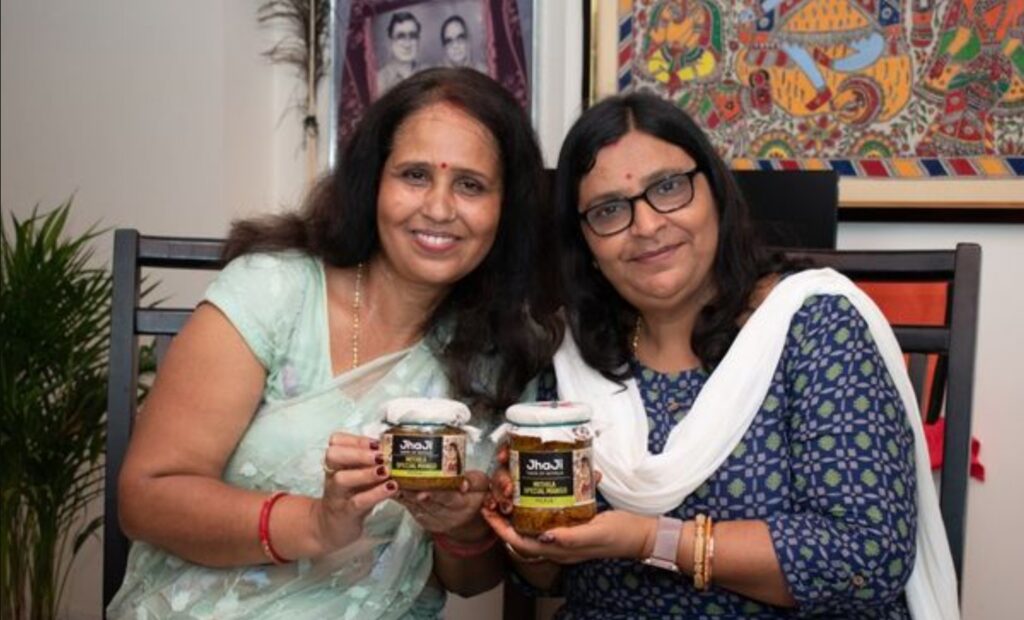
From Traditional Skills to Modern Entrepreneurship
The JhaJi Store story challenges the conventional image of a startup founder.
Neither Kalpana nor Uma began their journey as a typical technology entrepreneur.
Their business was built around skills developed over years through personal and family experience.
They took traditional knowledge and asked a modern question: can this become a scalable business?
The answer came through a combination of product development, licensing, digital sales, television exposure and customer demand.
Their journey shows that entrepreneurship can begin with an existing skill.
A family recipe, a local craft, an understanding of regional culture or a traditional product can become the foundation for a business when combined with the right operational and commercial strategy.
The Power of Not Giving Up
Perhaps the strongest lesson from Kalpana and Uma Jha’s entrepreneurial journey is the importance of persistence.
They went on Shark Tank India hoping for investment.
They did not receive a deal during their first pitch.
They returned home disappointed but continued to build their company.
The business kept growing.
The founders kept working.
And eventually, the story took an unexpected turn when the Sharks visited their operations and later invested in the venture.
Their journey is a reminder that rejection is not always the end of an opportunity.
Sometimes, what happens after a setback matters more than the setback itself.
The JhaJi Store Journey Continues
From a small beginning rooted in a shared passion for pickle-making, Kalpana Jha and Uma Jha built a brand that introduced the flavours of Mithila to consumers across India.
Their appearance on Shark Tank India brought them national recognition.
Their initial failure to secure funding brought disappointment.
But their determination to continue building the business eventually led to a new opportunity.
Today, the story of JhaJi Store is about more than pickles.
It is about two women who saw potential in their traditional skills, took the risk of becoming entrepreneurs and continued moving forward even when their first major business opportunity did not go as planned.
For Kalpana and Uma, the journey from Darbhanga to Shark Tank India and back again became proof that an entrepreneur’s story is not defined by a single pitch.
Sometimes, the most important part of the story begins after the cameras stop rolling.