








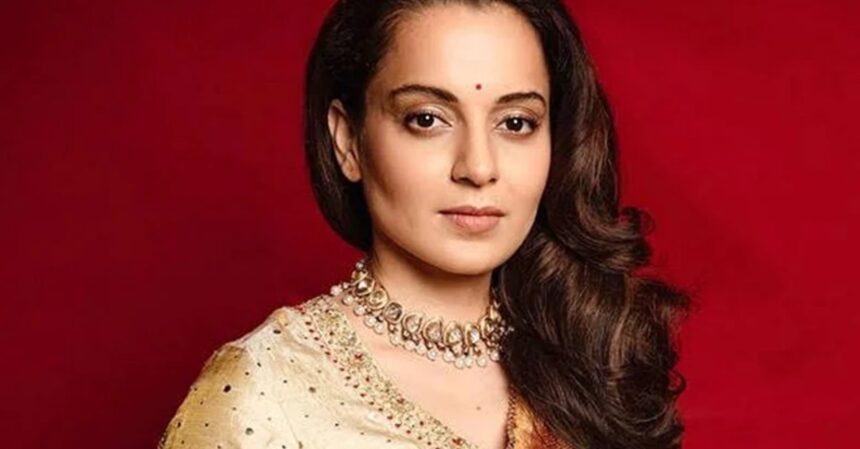
Kangana Ranaut has once again criticised sections of the Hindi film industry, this time questioning what she describes as Bollywood’s continued “love affair” with Pakistan. Her comments come amid her ongoing verbal exchange with veteran actor Naseeruddin Shah and ahead of the release of Sunny Deol’s Batwara 1947.
Speaking to ANI, Ranaut accused sections of the film industry of displaying what she considers selective concern over political and social issues. She also questioned why some celebrities who had spoken about protests at Jantar Mantar had, in her view, not shown the same level of concern about developments involving children in Jharkhand.
The actor-politician then turned her attention to Naseeruddin Shah, defending her earlier criticism of the veteran actor and questioning his repeated references to Pakistan in films, interviews and public statements.
Her comments have added another chapter to an increasingly political exchange between two prominent figures from Indian cinema.
See more of our coverage in your search results.
Add Hunterfly on GoogleKangana Ranaut Questions Bollywood’s Focus on Pakistan
Ranaut’s latest comments centre on her perception that Bollywood has maintained an unusually strong interest in Pakistan-related themes.
While speaking to ANI, she questioned why the subject continues to feature prominently in films, interviews and public discussions decades after Partition.
Ranaut said:
“Whether it is their films, their statements, or their interviews, when will this love affair with Pakistan end?”
She continued by referring to the passage of time since Partition and asked why, in her view, the subject remained such a recurring theme.
“So many years have passed since Partition, yet why doesn’t this love story come to an end?”
The remarks were clearly framed as a criticism of what Ranaut perceives as a broader trend rather than a comment about one particular film.
See more of our coverage in your search results.
Add Hunterfly on GoogleHowever, her statement comes at a time when a number of Partition-related and India-Pakistan stories continue to attract interest in Indian cinema and streaming.
Why Naseeruddin Shah Is Part of the Latest Dispute
Ranaut’s comments were also connected to her ongoing disagreement with Naseeruddin Shah.
The two actors have previously exchanged criticism over political and social issues, with Ranaut frequently using social media to comment on Shah’s public statements.
See more of our coverage in your search results.
Add Hunterfly on GoogleExplaining her latest criticism of the veteran actor, Ranaut referred to a video she described as “distasteful” and said that Shah’s films, interviews and statements had repeatedly dealt with Pakistan.
She said:
“I said this about Naseeruddin Shah because he had made such a distasteful video in which he was making threats of this kind.”
Ranaut subsequently questioned what she characterised as Shah’s continued focus on the neighbouring country.
Her remarks represent her interpretation of Shah’s public record and should not be treated as an established fact that the actor has a particular political allegiance.
Ranaut’s Earlier Remark About Shah
The latest statement follows an earlier social media attack in which Ranaut criticised Shah in Hindi.
In that post, she contrasted her own political position with what she portrayed as Shah’s.
Ranaut wrote that she was proud to be committed to fighting for the country that provides her livelihood, while accusing Shah of earning his livelihood in India while advocating for a neighbouring country.
The language marked a significant escalation in their public disagreement.
Ranaut has previously been outspoken about actors and filmmakers whose political positions differ from her own, particularly when she believes their comments concern India’s national interests.
Shah, meanwhile, has been an outspoken public figure on several social and political questions over the years.
What Did Kangana Say About Jantar Mantar and Jharkhand?
Ranaut also connected her Pakistan-related criticism to her comments about protests.
She argued that some members of the film industry had expressed strong concern about events at Jantar Mantar, but questioned why similar attention was not being given to children in Jharkhand.
She said:
“So when a situation like this was unfolding at Jantar Mantar, they were all shedding crocodile tears. But now that children in Jharkhand are facing this kind of oppression, aren’t they Gen Z too?”
Ranaut then questioned whether young people were only described as Gen Z when they participated in protests against the government or criticised the Prime Minister.
She accused the film industry of hypocrisy and argued that celebrities should show consistency when commenting on issues involving young people.
These are Ranaut’s political assertions and characterisations; independent verification would be required for broader claims about the film industry’s collective response to the respective events.
The ‘Crocodile Tears’ Remark
Ranaut has repeatedly used the phrase “crocodile tears” when criticising what she sees as selective outrage among public figures.
In her ANI interaction, she argued that celebrities who had expressed concern about one set of protesters should also speak about other young people facing difficulties.
She said:
“This hypocrisy in the film industry will not work.”
The remark reflects a recurring theme in Ranaut’s political commentary: the belief that celebrities should apply the same standards to different political or social situations.
Her comments have historically generated strong reactions because they combine her position as an actor with her role as an elected politician.
Batwara 1947 Brings Partition Back Into the Conversation
Ranaut’s comments come ahead of the release of Sunny Deol’s Batwara 1947, a film whose title and subject connect directly to the Partition of India.
Partition remains one of the most significant and traumatic events in the modern history of the Indian subcontinent.
Millions of people were displaced during the division of British India in 1947, while the period was also marked by widespread communal violence and loss of life.
Cinema has repeatedly returned to Partition as a subject, using stories of families, migration, romance and separation to explore its consequences.
Films dealing with Partition therefore inevitably involve India-Pakistan relations, even when their primary focus is personal rather than political.
Ranaut’s criticism raises a broader question about how frequently the Hindi film industry should revisit that history and how such stories should be presented.
Why Partition Continues to Appear in Indian Cinema
The Partition of 1947 continues to influence Indian popular culture because its consequences remain embedded in family histories and collective memory.
Filmmakers have approached the subject from very different perspectives.
Some have focused on political history, while others have told intimate stories involving families separated by borders.
Romantic narratives can also use Partition as a backdrop for examining separation and displacement.
This diversity means that the presence of Pakistan or Partition in a film does not automatically indicate a particular political position.
Ranaut, however, is questioning what she considers to be a recurring pattern in the industry’s broader public discourse.
Main Vaapas Aaunga and Naseeruddin Shah
The controversy also arrives amid attention surrounding Imtiaz Ali’s Main Vaapas Aaunga, which stars Naseeruddin Shah and explores a romance affected by Partition.
The film’s subject naturally brings questions of India, Pakistan and the historical division of the subcontinent into the conversation.
Ranaut’s comments therefore come against a backdrop in which Shah is once again associated with a story connected to Partition.
However, it is important not to conflate an actor’s participation in a fictional film with the actor’s personal political views.
Actors frequently portray characters or participate in stories dealing with historical and political subjects without necessarily endorsing every idea represented in those works.
The Bigger Debate Over Bollywood and Politics
Ranaut’s latest remarks fit into a much larger debate about the relationship between Bollywood and politics.
Indian film personalities have increasingly become active participants in public political conversations.
Some celebrities use their platforms to support government policies, while others criticise political decisions or social developments.
The result is that statements made by actors can generate news coverage far beyond entertainment.
Ranaut is among the most politically outspoken actors in the industry and has also entered electoral politics.
Consequently, her comments about Bollywood frequently attract attention not simply as celebrity statements but as political commentary.
Why Ranaut’s Comments Are Likely to Generate Debate
The phrase “love affair with Pakistan” is deliberately provocative.
India and Pakistan have a complicated relationship shaped by Partition, multiple wars, diplomatic tensions, cross-border terrorism, cricket rivalry and extensive cultural connections.
The film industries of both countries have also historically been influenced by shared languages, music and artistic traditions.
At the same time, political tensions have periodically affected cultural exchanges between the two nations.
Ranaut’s criticism sits within this complicated history.
Her argument is that Bollywood should move beyond what she considers an excessive preoccupation with Pakistan. Critics of that position could argue that historical and cultural subjects remain legitimate material for filmmakers.
That disagreement is likely to continue as long as Indian cinema revisits Partition and India-Pakistan relations.
Separating Cinema From Political Allegiance
One important distinction in this debate is between depicting Pakistan in cinema and supporting Pakistan politically.
A film can portray Pakistani characters, Partition-era relationships or cross-border romance without advocating a political position.
Likewise, an actor’s decision to participate in a film about Partition does not, by itself, establish their political beliefs.
Any reporting on the controversy should therefore distinguish between Ranaut’s allegations and verifiable facts about individual films, interviews and statements.
This distinction is especially important when public figures make claims about another person’s loyalties.
A Long-Running Public Disagreement
The latest comments are unlikely to be viewed in isolation.
Ranaut and Shah have both been involved in public debates over political and social issues, although their approaches and ideological positions are markedly different.
Their disagreements have periodically resurfaced whenever either actor makes a statement that the other side interprets as politically significant.
Ranaut’s latest comments suggest that the disagreement remains unresolved.
Whether Shah responds directly remains to be seen.
What Happens Next?
For now, the focus is on Ranaut’s latest criticism and the reaction it generates.
The release of Batwara 1947 could further intensify discussion around Partition, India-Pakistan relations and the way Hindi cinema portrays the history of the subcontinent.
Meanwhile, any response from Naseeruddin Shah could potentially push the dispute back into the headlines.
For readers, the key distinction is between Ranaut’s political opinion, Shah’s publicly reported statements and independently verifiable information about the films and events mentioned in the debate.
Final Take
Kangana Ranaut has once again turned the spotlight on Bollywood’s relationship with politically sensitive subjects, questioning what she describes as the industry’s continuing “love affair” with Pakistan.
Her comments came while discussing Naseeruddin Shah and followed a series of disagreements between the two actors. Ranaut defended her earlier criticism of Shah and questioned why Pakistan continues to feature prominently in his films, interviews and statements.
She also criticised what she described as selective concern among Bollywood personalities over youth-related protests, comparing attention given to Jantar Mantar with what she said was insufficient attention to children in Jharkhand.
The remarks have opened up a wider conversation about Bollywood, political expression, Partition cinema and India-Pakistan relations. While Ranaut has presented a strong personal and political argument, the broader debate involves questions that extend well beyond the two actors.