









Kriti Sanon has responded to the criticism surrounding her GIVA Raksha Bandhan advertisement, addressing social media users who questioned her outfit and the campaign’s decision to include pets in the festive concept.
The controversy began after the jewellery brand released its Raksha Bandhan campaign featuring Sanon in a contemporary Indo-western ensemble. Some viewers objected to her bralette-style blouse and cape, arguing that the outfit was inappropriate for a traditional festival.
The advertisement also showed Sanon tying a rakhi to a pet dog, another creative choice that attracted criticism online.
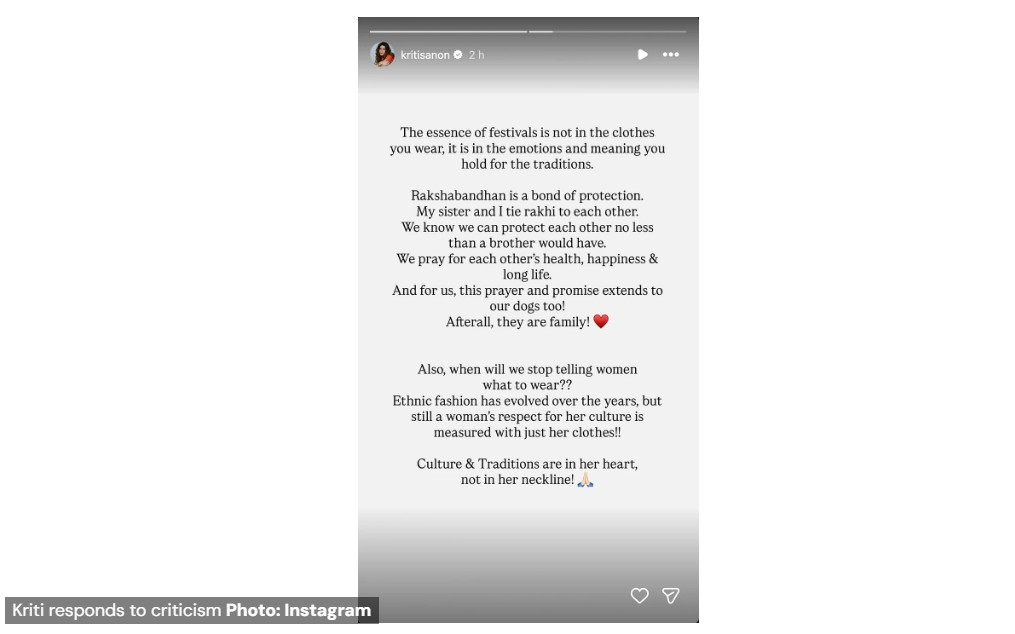
Rather than remaining silent, Sanon addressed the debate through her Instagram Stories, arguing that the significance of a festival should not be judged solely by what a woman wears.
See more of our coverage in your search results.
Add Hunterfly on GoogleShe also explained why the campaign included pets, saying that dogs are part of the family and that the spirit of the festival can extend to them.
Kriti Sanon Responds to the Backlash
The actor’s response directly addressed the criticism over her clothing.
According to her Instagram Story, Sanon argued that the essence of festivals lies in the emotions and meaning attached to traditions rather than in a particular style of clothing.
“The essence of festivals is not in the clothes you wear, it is in the emotions and meaning you hold for the traditions,” she wrote.
She then offered her own interpretation of Raksha Bandhan, explaining that the festival’s idea of protection is not limited to a brother-sister relationship.
See more of our coverage in your search results.
Add Hunterfly on Google“Rakshabandhan is a bond of protection,” Sanon wrote. “My sister and I tie rakhi to each other. We know we can protect each other no less than a brother would have. We pray for each other’s health, happiness & long life.”
Her comments shifted the focus from the advertisement’s styling to the underlying meaning of the festival.
Kriti Says Pets Are Part of the Family
Sanon also addressed one of the other major points of criticism: the appearance of a dog in the advertisement.
See more of our coverage in your search results.
Add Hunterfly on GoogleThe GIVA campaign incorporates a pet into the family’s Raksha Bandhan celebration, with the concept extending the festive gesture towards the dog.
Some social media users had questioned why a pet was included in a campaign traditionally centred on siblings.
Sanon defended the creative choice by explaining that pets are family members for her and her sister.
“And for us, this prayer and promise extends to our dogs too! Afterall, they are family!” she wrote.
Her explanation provides context for the campaign’s decision to include the pet.
Rather than presenting the dog as replacing the sibling relationship, Sanon’s comments suggest that the campaign was intended to portray a broader understanding of family and affection.
‘When Will We Stop Telling Women What to Wear?’
Sanon’s strongest criticism was directed at the scrutiny of women’s clothing.
She questioned why women continue to be told what they should wear when participating in cultural traditions.
“Also, when will we stop telling women what to wear??” she asked.
The actor then pointed to the evolution of ethnic fashion, arguing that clothing has changed over time while expectations surrounding women’s appearance have remained restrictive.
“Ethnic fashion has evolved over the years, but still a woman’s respect for her culture is measured with just her clothes!!” she wrote.
She concluded with a statement that became the central message of her response:
“Culture & Traditions are in her heart, not in her neckline!”
The comment directly challenged the idea that a woman’s choice of clothing can be used as a measure of her connection to culture.
Why Kriti Sanon’s Outfit Became Controversial
The GIVA advertisement features Sanon in an outfit that combines elements of contemporary fashion with a festive aesthetic.
The look includes an off-white bralette-style blouse, a cape and a draped skirt.
While the campaign appears to use an Indo-western interpretation of festive dressing, some viewers felt that the outfit did not fit their expectations of Raksha Bandhan.
The criticism was particularly focused on the blouse.
Several social media users had described the outfit as revealing and argued that more conventional ethnic clothing would have been appropriate for the occasion.
However, Sanon’s response makes clear that she does not accept clothing as the appropriate standard for measuring cultural respect.
Her argument is essentially that participating in a tradition and believing in its values are separate from following a prescribed dress code.
The Dog in the GIVA Advertisement Also Drew Reactions
The campaign’s treatment of the pet became another source of debate.
In the advertisement, the dog is included in the Raksha Bandhan setting and becomes part of the family’s celebration.
For some viewers, this was a creative representation of modern households in which pets are considered members of the family.
Others felt that the presence of the dog distracted from the traditional sibling relationship at the centre of Raksha Bandhan.
Sanon’s response made her position clear: she considers her dogs part of the family and therefore sees no contradiction in extending the sentiment of protection and affection towards them.
That explanation also sheds light on the campaign’s broader creative direction.
Kangana Ranaut Joins the Debate
The controversy gained another layer when actor and BJP MP Kangana Ranaut also criticised the advertisement.
Ranaut questioned the choice of outfit in connection with the Raksha Bandhan ritual and described the advertisement as “intentionally creepy.”
Her criticism added another prominent voice to an already active online discussion.
While Sanon directly addressed the backlash through her Instagram Stories, Ranaut’s comments contributed to the wider debate over how women should dress when participating in traditional celebrations.
The contrasting positions of the two actors have given the controversy an additional dimension.
A Larger Debate About Women, Clothing and Tradition
The disagreement surrounding the advertisement goes beyond one jewellery campaign.
At its centre is a familiar debate about the relationship between women’s clothing and cultural identity.
Traditional festivals often come with social expectations about how people should dress and behave. Women, in particular, can face intense scrutiny when their clothing differs from conventional expectations.
Sanon’s response challenges that framework.
Her argument is that culture cannot be reduced to an outfit and that a person’s commitment to family traditions should not be judged by the amount of skin covered by their clothing.
Critics, meanwhile, have argued that cultural context matters and that brands should consider the expectations surrounding the festivals they use in commercial campaigns.
These opposing viewpoints explain why the GIVA advertisement has generated such a strong reaction.
Can Modern Fashion and Traditional Festivals Coexist?
The controversy also raises an important question for contemporary advertising.
Indian fashion has changed significantly over the years. Designers and celebrities regularly combine traditional silhouettes with modern cuts, fabrics and styling.
Festive fashion is no longer limited to one fixed definition of what constitutes appropriate clothing.
At the same time, festivals such as Raksha Bandhan carry longstanding cultural associations.
For advertisers, combining those two worlds can be challenging.
A campaign can attempt to modernise a traditional festival while still retaining its emotional core. But if the styling appears too disconnected from familiar expectations, audiences may question the campaign’s cultural sensitivity.
GIVA’s advertisement has become an example of precisely that tension.
Sanon’s Supporters Defend Her Position
The backlash has also prompted support for Sanon from people who believe the discussion has focused too heavily on her clothes.
Supporters have argued that the central message of Raksha Bandhan is the bond between loved ones and that the festival’s emotional meaning does not depend on whether someone wears a traditional saree, salwar suit or contemporary outfit.
Some have also pointed out that the inclusion of pets reflects changing family structures and the increasing role of companion animals in people’s lives.
From this perspective, the advertisement is an attempt to present a modern family celebrating a familiar festival.
Critics See the Campaign Differently
Those criticising the campaign have taken a different position.
Their argument is that advertising associated with religious or cultural festivals carries a responsibility to understand the symbolism attached to the occasion.
For these viewers, the outfit and the pet-focused element are not merely creative decisions. They change the way the festival is represented.
It is this difference in interpretation that has driven much of the social-media debate.
Importantly, online criticism represents individual reactions rather than an established consensus among viewers.
Kriti Sanon’s Response Shifts the Conversation
Before Sanon responded, much of the discussion centred on whether her outfit was suitable for Raksha Bandhan.
Her Instagram Story reframed the issue.
Instead of defending the outfit purely on fashion grounds, she questioned the premise that clothing should determine whether a woman is respecting her culture.
Her comments also introduced a personal dimension by explaining how she and her sister celebrate the festival and why their dogs are included in their understanding of family.
That made the response less about defending a brand advertisement and more about explaining her own interpretation of the festival.
The GIVA Controversy Reflects Changing Ideas of Family
The advertisement’s pet element is particularly relevant to the changing way families are represented in commercial campaigns.
For many younger households, dogs and other pets are considered family members. Brands increasingly reflect this reality in advertising, particularly in campaigns related to lifestyle and home life.
GIVA’s decision to incorporate a dog into a Raksha Bandhan advertisement follows that broader trend.
But the reaction demonstrates that such representations can also challenge conventional ideas about cultural rituals.
Sanon’s defence suggests that affection, protection and family bonds can extend beyond traditional categories.
Where Does the Debate Go From Here?
For now, the GIVA advertisement remains the subject of competing interpretations.
Kriti Sanon has defended the campaign and challenged criticism of her clothing. Kangana Ranaut has criticised the advertisement’s styling and described the creative approach negatively.
Meanwhile, social media users remain divided over whether the campaign represents a modern interpretation of Raksha Bandhan or moves too far away from traditional expectations.
The debate is unlikely to be resolved simply by deciding whether one outfit is appropriate.
The deeper issue concerns who gets to define cultural expression in contemporary India—and whether women’s clothing should be part of that definition.
Kriti Sanon’s Message: Tradition Is More Than Clothing
Kriti Sanon’s response makes her position unmistakable.
For the actor, Raksha Bandhan is fundamentally about love, protection, family and shared prayers for one another’s wellbeing.
She does not believe those values depend on wearing a particular type of clothing.
Her decision to speak out also places the advertisement within a broader conversation about the scrutiny women face over their appearance.
Whether audiences agree with her interpretation or prefer a more traditional presentation, her response has shifted the discussion from a simple fashion controversy to a larger debate about cultural identity and personal choice.