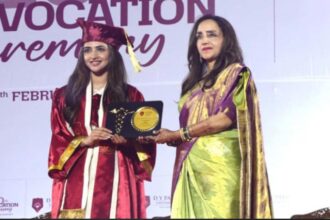









Priyangshee Sil’s journey with Flowers of Acacia began almost by accident. The actor had travelled to Chandigarh simply to accompany a friend and had no plans to audition for a film. A casual conversation with the team, however, eventually led to an audition — and then to one of the most challenging performances of her career.
Directed by Anmol Sidhu and presented by Shonali Bose, Flowers of Acacia has travelled from the New York Indian Film Festival to the Indian Film Festival of Melbourne. At the centre of the film are five women who work as orchestra dancers at rural Punjabi weddings, navigating a world shaped by economic uncertainty, social judgement and survival.
Sil plays Simmi, a Bengali woman who has spent much of her life in Punjab. For the actor, portraying someone caught between two cultural identities required far more than learning lines or choreography. It meant spending months away from her familiar surroundings and gradually understanding the world her character inhabited.
Priyangshee Sil discovered Simmi after an unexpected audition
Sil did not initially travel to Chandigarh with the intention of joining the film. She was there accompanying a friend when the team learned about her acting background and suggested that she audition.
See more of our coverage in your search results.
Add Hunterfly on GoogleSince she was not fluent in Punjabi, the audition was conducted in Hindi and Bengali, her mother tongue. She was eventually selected for the role, but it was only after being cast that she began discovering who Simmi really was.
The character gave Sil an entry point into a world defined by hardship, responsibility and quiet resilience. Simmi is Bengali by origin but has been shaped by years of living in rural Punjab, making her identity more layered than a simple cultural distinction.
Living in rural Punjab helped shape the performance
Coming from a Bengali cinema and television background, Sil had to deliberately move away from many of the familiar reference points she had developed as an actor.
She spent months in Rampura near Bathinda, observing village life, listening to Punjabi and learning about everyday customs. The experience helped her understand that Simmi’s relationship with Punjab was not merely geographical. It had become part of who she was.
Sil also credits the film’s team for making the transition easier. Rather than treating her as an outsider when she struggled with language or unfamiliar situations, the people around her helped her adapt.
See more of our coverage in your search results.
Add Hunterfly on GoogleThat support eventually allowed the actor to move beyond the technical process of playing Simmi and begin approaching the character from an emotional perspective.
From Bharatanatyam to the world of orchestra dancers
One of the most significant challenges involved movement.
Sil is trained in Bharatanatyam, but the performance language required for Simmi was fundamentally different. Instead of relying on her classical training, she had to understand and reproduce the style and energy of orchestra dancers.
See more of our coverage in your search results.
Add Hunterfly on GoogleThe production even took the actors into real village wedding environments, where guests initially believed they were genuine performers. For Sil, those experiences provided an unusually direct understanding of the profession depicted in the film.
Her preparation also extended into her personal life. She stepped away from social media for nearly six months and deliberately isolated herself from many of her usual distractions.
The intention was to understand Simmi’s emotional state — particularly the pressure, uncertainty and loneliness that accompany a life built around survival.
Real-life performers changed how Sil saw the characters
Perhaps the most lasting part of Sil’s preparation came through her interactions with women who actually worked as performers.
Their experiences demonstrated how dramatically the reality behind a stage performance can differ from what an audience sees.
Sil recalled one particularly powerful incident involving a performer who learned during a show that her father had died. She nevertheless completed her performance before allowing herself to grieve.
Another woman described periods when she did not have a secure place to live but continued working because her family relied on her income.
For Sil, such encounters reinforced an important idea at the heart of Flowers of Acacia: the person performing in front of an audience may be carrying an enormous private burden that remains completely invisible from the other side of the stage.
Anmol Sidhu created space for Sil to find Simmi
Sil speaks particularly warmly about director Anmol Sidhu’s approach to actors.
Rather than dictating how emotions should appear, she says Sidhu created an environment in which the required feelings could emerge naturally. She describes him as a teacher as much as a filmmaker.
That approach resonated with Sil’s own theatre background with Nandikar, where working with directors who nurture performances has influenced her understanding of acting.
According to the actor, Sidhu’s guidance helped her reach emotional layers in Simmi that she may not have discovered independently.
Flowers of Acacia takes a local story to international audiences
The film’s festival journey has given Sil another reason to feel connected to the project.
After its appearance at the New York Indian Film Festival, Flowers of Acacia is now travelling to Melbourne, bringing its story of rural Punjabi women to another international audience.
For Sil, that response is particularly meaningful because the film is deeply rooted in a specific social and cultural environment.
She believes the film’s themes — identity, survival, dignity and hope — can cross geographical and linguistic boundaries precisely because they emerge from an authentic local reality.
The international response also gives visibility to women whose lives are rarely represented with nuance on screen.
Simmi has changed Sil’s approach to acting
Looking back at the experience, Sil considers Simmi an important turning point in her acting journey.
The role required her to adapt physically, emotionally and culturally while working in an unfamiliar language and environment. More importantly, it encouraged her to take greater risks with the characters she chooses.
The actor now sees unfamiliar territory as an opportunity rather than something to avoid. In that sense, Simmi’s journey has influenced Sil beyond the film itself.
A story about resilience and unseen strength
Sil hopes audiences come away from Flowers of Acacia with greater empathy for the women represented in the film.
Their lives are marked by social judgement, financial hardship and personal sacrifice, yet the characters continue to move forward with dignity.
For Sil, resilience is the film’s emotional core. She hopes viewers will look beyond the assumptions surrounding orchestra dancers and recognise the individuals behind those performances.
The film’s international festival journey, meanwhile, reflects the growing ability of regional Indian stories to travel without losing their cultural specificity.