



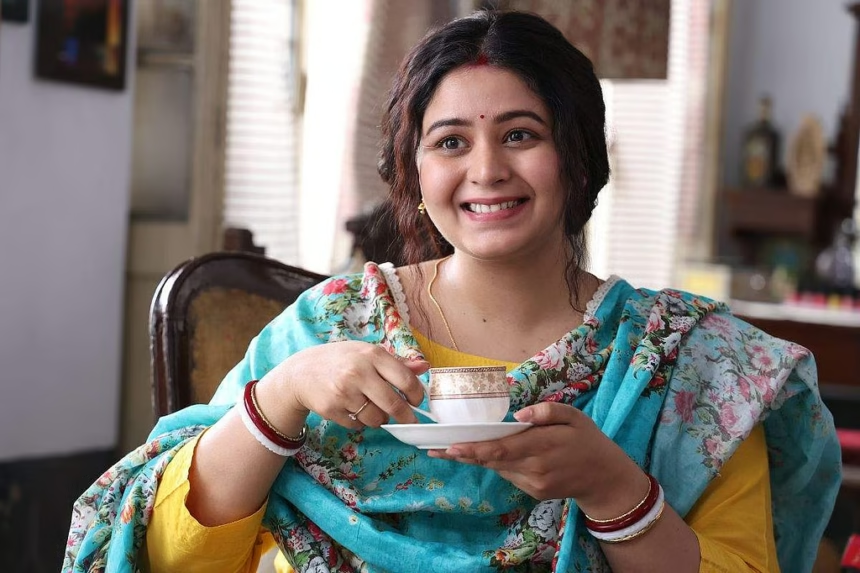
Ritabhari Chakraborty has opened up about body shaming, social-media trolling and her physical transformation for Fatafati, in which she plays Phullora, a plus-size woman who dreams of becoming a fashion influencer. The actor says the film is particularly relevant at a time when online abuse and unrealistic beauty standards continue to shape how people view themselves and others.
Ritabhari Chakraborty is returning to filmmaker Aritra Mukherjee with Fatafati, their second collaboration after Brahma Janen Gopon Kommoti.
The Bengali film puts body image and social prejudice at the centre of its story, with Chakraborty playing Phullora, a plus-size woman who aspires to make a name for herself as a fashion influencer.
The title Fatafati, a Bengali expression associated with something excellent or impressive, takes on an additional meaning in the film: physical appearance should not determine whether someone is allowed to pursue their ambitions.
See more of our coverage in your search results.
Add Hunterfly on GoogleAhead of the film’s release, Chakraborty discussed her connection with the character, her own experiences with body shaming and the importance of changing the way society talks about people’s bodies.
Ritabhari Says Phullora Is Different From Her
Although Chakraborty could relate to some aspects of Phullora’s experiences, she said the character’s life was very different from her own.
Phullora has spent much of her life being told that her weight makes her unattractive. As a result, she develops deep insecurities and struggles to believe that she is good enough.
Chakraborty said she, in contrast, grew up with considerable confidence, which she attributed partly to her mother.
However, she identified one important similarity between herself and Phullora: both are fighters.
See more of our coverage in your search results.
Add Hunterfly on GoogleThe actor also acknowledged that body shaming has nevertheless been part of her professional experience. After around 15 years in the industry, she said she had encountered different forms of commentary about her appearance.
‘There Is an Ardent Need’ for Body Positivity
According to Chakraborty, conversations around body positivity remain extremely necessary.
She pointed to the reaction to Fatafati itself as an example. While promoting the film, she said, social-media comments included negative remarks and body-shaming.
See more of our coverage in your search results.
Add Hunterfly on GoogleThe actor drew a distinction between expressing genuine concern about someone’s health and deliberately insulting a person’s appearance.
For Chakraborty, derogatory comparisons and comments about someone’s body cross the line from opinion into personal humiliation.
She believes that distinction needs to be recognised more clearly, particularly on social media.
Ritabhari’s Definition of Body Positivity
Chakraborty’s perspective on body positivity is closely linked to health rather than a particular physical ideal.
Her view is that different body types can be healthy, and that appearance alone cannot determine someone’s wellbeing.
She argued that people can become so focused on achieving a body that society considers desirable that they overlook basic health and nutrition.
For her, the more important question is whether a person is healthy rather than whether they conform to a specific shape or size.
Why Should a Curvy Character Be Treated Differently?
One of the questions Chakraborty raised is why a character’s body shape needs to become a major talking point at all.
She argued that people simply have different bodies and that a character’s physical appearance should not necessarily overshadow the character itself.
She pointed to performers such as Shefali Shah and Deepika Padukone as examples of actors whose performances and abilities can be more important than discussions about their bodies.
In her view, unless a character’s appearance is central to a larger-than-life concept, audiences should ideally focus on the person and the story rather than constantly analysing how an actor looks.
Ritabhari Says Her Focus Has Shifted From Appearance to Health
Chakraborty also spoke about her own relationship with body image.
She said she had previously been much more conscious of her body. However, following surgeries and the physical challenges associated with recovery, her priorities changed.
Today, she said, her focus is primarily on nutrition and health rather than simply maintaining a particular appearance.
That perspective also influenced how she approached the physical demands of Fatafati.
Ritabhari Gained 25 Kg for Fatafati
One of the most talked-about aspects of Chakraborty’s preparation for Fatafati was the weight gain she undertook for the role.
The actor gained approximately 25 kg to portray Phullora.
After completing the film, she said she returned to her previous weight through a structured approach involving a healthy diet and planned exercise.
She said it took her around six months to lose 19 kg, with nutritionist Luke Coutinho assisting her during the process.
The actor indicated that her weight-loss journey was approached as a gradual health-focused process rather than a crash transformation.
Working With Swastika Dutta and Abir Chatterjee
Fatafati also gave Chakraborty the opportunity to work with Swastika Dutta and Abir Chatterjee.
She described Dutta warmly despite the fact that her character, Biki Sen, is negative in the film.
Chakraborty also praised Chatterjee’s calm and composed personality and revealed that she frequently teased him during their time working together.
According to the actor, their on-screen chemistry worked well.
She was particularly appreciative that Chatterjee chose to participate in a project where the story was not built solely around his character.

A Second Collaboration With Aritra Mukherjee
Fatafati marks Chakraborty’s second collaboration with director Aritra Mukherjee following Brahma Janen Gopon Kommoti.
Their first film also dealt with a social subject and received attention for addressing an issue that is often overlooked in mainstream entertainment.
Chakraborty believes films can do more than simply perform at the box office. When a movie encourages audiences to question established attitudes and opens a public conversation, she believes cinema can have a meaningful social impact.
She described Brahma Janen Gopon Kommoti as groundbreaking and expressed hope that Fatafati would similarly make audiences think.
Why Fatafati Is Relevant in the Age of Social Media
For Chakraborty, the film’s message has become particularly relevant because of the rise of online trolling.
She argued that the virtual nature of social media should not make people believe they can say things online that they would never say directly to another person’s face.
The actor also highlighted the difference between humour and humiliation.
Having an opinion, she suggested, does not give anyone the right to strip another person of their dignity. Constructive criticism can have value, but deliberately offensive comments are different.
That distinction forms an important part of the film’s wider conversation about how people treat others based on their appearance.
Ritabhari’s Fashion Philosophy: ‘Comfort Chic’
Despite playing a character deeply interested in fashion, Chakraborty’s own approach to clothing is relatively straightforward.
She described her style as “comfort chic.”
The actor said she enjoys fashionable clothing but will not wear something if she does not feel comfortable or confident in it.
For her, confidence and comfort are essential parts of personal style.
What’s Next for Ritabhari Chakraborty?
Following Fatafati, Chakraborty had several projects lined up.
She said she was scheduled to begin shooting for ** Apanjan ** in London with Jeetu Kamal.
She also mentioned recording a song with singer Nikhita Gandhi, describing the project as something she was particularly excited about.
Fatafati’s Message Goes Beyond Appearance
At its core, Fatafati is not simply a story about a woman who wants to enter the fashion world.
Through Phullora, the film examines the social expectations placed on women and the assumption that certain body types are more deserving of attention, confidence or success.
Chakraborty’s own comments reinforce the film’s central idea: a person’s body should not become a measure of their worth.
Her transformation for the role may have attracted attention because of its scale, but the actor believes the more important conversation is what happens after the physical transformation is no longer the headline.