





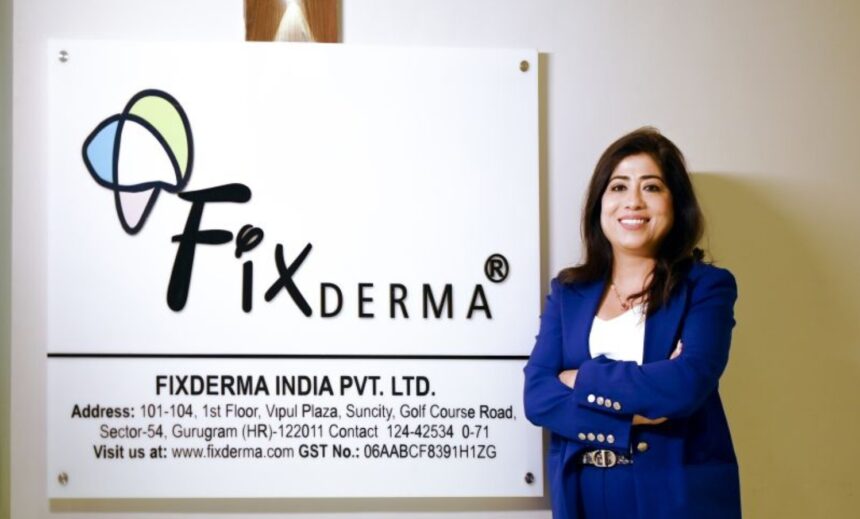
In an Indian beauty market increasingly shaped by social media trends, celebrity launches and fast-growing direct-to-consumer brands, Fixderma has followed a markedly different route.
The skincare company, associated with co-founder Shaily Mehrotra, has built its identity around dermatology, product efficacy and distribution rather than relying solely on the latest viral beauty trend. Its journey offers an interesting case study in how a consumer brand can attempt to combine clinical credibility with mass-market accessibility.
Mehrotra recently discussed the company’s growth journey during an appearance on the RESTLESS podcast with Ayush Shukla, offering a closer look at the decisions that shaped Fixderma’s business.
What emerges is less a story about overnight success and more one about manufacturing, distribution, professional relationships and the patience required to build consumer trust.
See more of our coverage in your search results.
Add Hunterfly on GoogleFixderma’s Early Strategy Was Rooted in Dermatology
The Indian skincare market has changed dramatically over the past decade.
Consumers today have access to ingredient-focused products, dermatology content, online consultations and thousands of skincare brands. But when Fixderma was establishing itself, the market was far more fragmented.
For Mehrotra and the early team, building credibility meant going beyond attractive packaging and conventional consumer advertising.
The company concentrated on dermatologists and professional recommendations, making clinical positioning a central part of its strategy.
That approach helped establish a distinction between Fixderma and brands competing primarily on cosmetic appeal.
See more of our coverage in your search results.
Add Hunterfly on GoogleThe underlying proposition was straightforward: a skincare product should first solve a problem and then become a lifestyle product.
That philosophy remains particularly relevant as consumers become more informed about active ingredients, skin barriers, acne management and sun protection.
From a Small Team to a Wider Distribution Network
Fixderma’s early expansion was not built around the kind of large-scale marketing infrastructure associated with many contemporary D2C launches.
See more of our coverage in your search results.
Add Hunterfly on GoogleThe company began with a relatively small team and concentrated on building its presence across regional markets.
This meant developing relationships with doctors, retailers and distributors while gradually learning which products and categories resonated with consumers.
The strategy required considerably more patience than a purely digital-first launch.
Instead of treating online visibility as the sole indicator of brand strength, the business had to establish repeat demand and physical distribution.
That distinction is important.
A product can become popular on social media without necessarily developing sustainable retail demand. Conversely, a brand with strong distribution can sometimes build a significant consumer base without generating constant online buzz.
Fixderma’s story sits closer to the second model.
Why Manufacturing Became a Strategic Turning Point
One of the more significant aspects of Mehrotra’s account is the importance of manufacturing control.
Early dependence on third-party manufacturing reportedly exposed the business to inconsistencies in product quality. For a skincare company whose proposition depends heavily on formulation and clinical performance, that presented a fundamental challenge.
Rather than simply accepting the limitations of outsourced production, the company moved toward establishing greater control over manufacturing.
It was a costly and operationally demanding decision.
However, manufacturing infrastructure can provide a consumer brand with advantages that extend beyond production capacity. Greater control can influence quality assurance, formulation development, consistency, inventory planning and the ability to respond to changing market requirements.
For a skincare business, those factors can ultimately become part of the brand’s competitive moat.
The Indian Skincare Consumer Is No Longer Defined by Metro Cities
Another important lesson from Fixderma’s expansion is the changing profile of India’s beauty and wellness consumer.
For years, premium beauty businesses frequently treated India’s largest metropolitan cities as the country’s primary consumer opportunity.
That picture has become considerably more complicated.
Consumers in smaller cities increasingly discover products through social media, marketplaces, dermatologists, pharmacies and quick-commerce platforms. They may be just as familiar with skincare ingredients and product claims as consumers in larger urban centres.
But their purchasing priorities can be different.
Value, product performance, availability and trust can carry considerable weight.
This creates an opportunity for brands that can combine clinical credibility with accessible pricing and widespread availability.
For Fixderma, the opportunity extended beyond selling skincare as a luxury or beauty accessory. Products addressing concerns such as acne, pigmentation, sun protection and skin-barrier care can be positioned around everyday health and personal care.
That broader interpretation of skincare has helped transform the category itself.
Four Channels Helped Shape Fixderma’s Growth
Fixderma’s business model illustrates why diversification can matter in the consumer healthcare and beauty sector.
1. Dermatologists and Professional Recommendations
Professional relationships have remained an important component of the brand’s clinical positioning.
Dermatologists can play a particularly influential role in skincare because consumers often seek professional guidance when dealing with persistent or complex skin concerns.
Building that trust requires consistency. A company cannot rely solely on advertising when its brand promise is connected to clinical credibility.
2. Offline Retail
Physical retail remains highly relevant despite the rapid growth of e-commerce.
According to figures cited in the company’s growth narrative, Fixderma has expanded its presence to more than 30,000 retail outlets.
A footprint of that scale changes the economics and visibility of a consumer brand.
It also makes products available to customers who may not begin their purchasing journey on Instagram, Google or a D2C website.
3. E-Commerce and D2C
The pandemic accelerated India’s shift toward online shopping, and skincare was among the categories that benefited from the transition.
Marketplaces and digital platforms gave consumers access to a much wider range of specialised products.
Fixderma was able to participate in this shift through e-commerce and direct digital channels, while platforms such as Nykaa, Amazon and quick-commerce services expanded the potential points of discovery.
The digital channel also gave the company another way to communicate product information directly to consumers.
4. International Expansion
Perhaps the clearest indication of the company’s ambition is its international footprint.
Fixderma has stated that its products are available across more than 35 countries, taking an Indian skincare brand beyond its domestic market.
International expansion, however, is considerably more complicated than simply listing a product overseas.
Brands entering new markets must contend with regulations, product registrations, distribution partners, consumer preferences, pricing structures and local competition.
For a clinical skincare company, maintaining product quality and regulatory compliance across markets becomes especially important.
Shaily Mehrotra’s Leadership Offers a Different Entrepreneurial Playbook
The startup ecosystem often celebrates speed.
Founders are encouraged to raise capital quickly, acquire customers aggressively and pursue rapid expansion. While those strategies can work, they are not universal formulas for building durable companies.
Mehrotra’s Fixderma journey presents a different model.
Its emphasis has been on product development, distribution, manufacturing and credibility—areas that are less glamorous than a viral campaign but potentially more durable.
For women entrepreneurs in particular, that distinction matters.
Women founders are often expected to demonstrate growth while simultaneously navigating assumptions about leadership, risk-taking and ambition. A business model built around long-term execution challenges the idea that entrepreneurial success must always look like rapid expansion.
Manufacturing Control Can Become a Competitive Advantage
Owning or controlling critical parts of the supply chain can be expensive.
But for brands in categories where formulation and consistency are central to consumer trust, manufacturing can become more than a backend function.
It can become strategic infrastructure.
Greater control allows companies to develop products according to their own specifications, monitor quality more closely and potentially respond faster to market changes.
Fixderma’s move in this direction demonstrates why supply-chain decisions made early in a company’s life can have consequences many years later.
The Bigger Shift: Skincare Is Becoming Problem-Solving
The most important change in India’s skincare market may not be the rise of any single brand.
It is the changing consumer mindset.
Skincare is increasingly being approached through the language of prevention, treatment, maintenance and wellness rather than simply cosmetics.
Consumers are asking questions about ingredients, formulations, skin types and evidence. They are also increasingly aware that different skin concerns require different approaches.
That shift creates opportunities for companies capable of educating consumers without making exaggerated promises.
It also raises the standard for brands.
Marketing may attract the first purchase, but product experience, transparency and consistency determine whether customers return.
Why Fixderma’s Story Matters Beyond Beauty
Fixderma’s evolution reflects a broader change taking place across India’s consumer economy.
Indian brands are no longer required to choose between mass-market accessibility and specialised positioning. With the right distribution model, a company can attempt to build both.
The combination of professional credibility, offline retail, e-commerce and international distribution gives Fixderma a model worth watching as India’s beauty and personal-care industry matures.
For entrepreneurs, perhaps the most useful lesson is not a particular marketing tactic.
It is the willingness to invest in the less visible foundations of a business.
Manufacturing facilities do not go viral. Distribution agreements rarely become social-media trends. Quality-control systems do not produce overnight fame.
But these are precisely the mechanisms that can determine whether a consumer brand survives after the hype disappears.
A Long-Term Approach to Building a Beauty Business
Shaily Mehrotra’s Fixderma journey ultimately challenges the assumption that every successful consumer company needs to follow the same high-speed playbook.
The brand’s reported expansion across India and international markets has been accompanied by a strategy centred on dermatology, product performance, manufacturing and multiple distribution channels.
That makes the story relevant not only to the beauty industry but also to the wider conversation about entrepreneurship in India.
In an environment where attention can be purchased quickly but trust takes years to build, Fixderma’s approach highlights a simple business truth: sustainable brand equity is created through repeated delivery, not temporary visibility.
For the next generation of women entrepreneurs, that may be the most valuable lesson of Mehrotra’s story.
Success does not always arrive with a viral launch.
Sometimes, it is built quietly—one formulation, one retailer, one doctor and one returning customer at a time.