








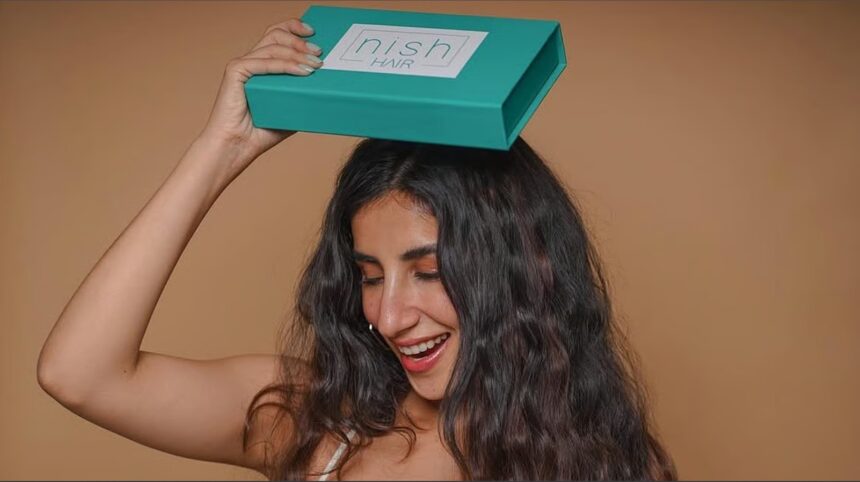
Actor-entrepreneur Parul Gulati’s journey with Nish Hair began with a simple idea at home and grew into a consumer brand built around hair extensions, personalised customer support and founder-led storytelling.
For many entrepreneurs, the first step towards building a business comes with a business plan, investors or a dedicated workspace. For Parul Gulati, it began much more simply — with her mother, a sewing machine and a problem that many women were reluctant to discuss openly.
Today, Gulati is known not only for her work as an actor but also as the founder of Nish Hair, a direct-to-consumer hair and beauty brand. Her entrepreneurial journey has attracted attention because of the way she combined a personal understanding of the problem with hands-on customer engagement and a willingness to build the company gradually.
In a conversation on the Restless podcast hosted by Ayush Shukla, Gulati discussed the less glamorous side of building Nish Hair, from its early days to the operational challenges that emerged as the company expanded.
See more of our coverage in your search results.
Add Hunterfly on GoogleHow Parul Gulati started Nish Hair with her mother
The idea behind Nish Hair emerged from a gap Gulati and her mother noticed in India’s hair-extension market.
Hair extensions and hairpieces were available, but quality products could be expensive and were often associated with celebrities, salons and professional stylists. Gulati saw an opportunity to make such products more accessible to everyday consumers.
The business initially took shape at home, with Gulati and her mother working with a sewing machine to create hairpieces.
That beginning was significant because the business was not built around a large initial marketing campaign. Instead, the founders focused on understanding what customers actually wanted and improving the products through direct feedback.
Hair concerns can also carry an emotional dimension. Hair thinning, hair loss and changes in hair volume can affect how people perceive themselves, making the category different from selling an ordinary fashion accessory.
See more of our coverage in your search results.
Add Hunterfly on GoogleThat understanding eventually became an important part of Nish Hair’s positioning.
Nish Hair’s founder-led approach to customers
One of the distinctive elements of Gulati’s entrepreneurial journey has been her direct involvement with customers.
Instead of relying exclusively on automated customer-service systems, she has spoken about personally interacting with potential buyers through social media. This included responding to Instagram messages, sending voice notes and helping customers understand which products could work for their hair.
See more of our coverage in your search results.
Add Hunterfly on GoogleFor a consumer trying a hair topper or extension for the first time, choosing the right colour, texture, length and application method can be confusing.
Personal guidance therefore became more than a customer-service exercise. It helped the brand address a category in which buyers may have concerns about appearance, fit and whether the product would look natural.
This founder-to-customer connection also became part of the company’s organic marketing strategy.
Rather than presenting Nish Hair simply as another beauty label, Gulati’s own presence helped communicate how and why the products were being used.
Why authenticity became important to Nish Hair
The beauty and personal-care market is crowded with brands competing for attention through advertisements, influencers and social-media campaigns.
Gulati’s approach was different in one important respect: she became closely associated with the product itself.
Her content demonstrated how hair extensions and toppers could be used, while conversations with customers helped normalise a subject that can still carry a stigma.
That founder visibility gave Nish Hair an additional layer of storytelling. Customers were not only seeing a product; they were also seeing the person behind the business explain its purpose.
For a D2C company, that can be particularly valuable because consumers have fewer opportunities to physically examine products before purchasing them online.
Scaling the company brought a new set of problems
Building a brand from scratch and managing a growing organisation are two very different challenges.
As Nish Hair expanded, Gulati has spoken openly about some of the difficulties that came with scaling the operation. These included internal vulnerabilities, payment-related issues and the need for stronger processes as the organisation became larger.
Such problems are not unusual for rapidly growing businesses. Systems that may work when a company has a small team can become inadequate once employees, inventory, payments and physical locations increase.
For Gulati, the experience meant learning that entrepreneurship is not simply about creating a popular product. It also requires financial controls, hiring systems, accountability and operational discipline.
The company eventually grew beyond its early home-based setup, with a larger team and physical retail presence becoming part of the business.
Parul Gulati’s hiring philosophy
Gulati has also spoken about placing significant importance on attitude while building her team.
For a founder who entered entrepreneurship without following a conventional business-school route, building a capable team became an important part of the company’s evolution.
The approach reflects a broader reality of early-stage businesses: founders often have to learn management while simultaneously managing growth.
As Nish Hair expanded, responsibilities increasingly had to be distributed across different functions, including operations, warehousing, styling and customer experience.
The transition from doing almost everything personally to building a team capable of running different parts of the organisation is one of the less visible milestones in a founder’s journey.
What Shark Tank India meant for Parul Gulati
Gulati’s appearance on Shark Tank India Season 2 brought additional attention to Nish Hair.
For many entrepreneurs, appearing on a nationally televised business programme is as much about visibility as it is about investment.
Gulati used the platform to present her business and defend her assessment of its value. The appearance also introduced Nish Hair to an audience far beyond the brand’s existing customer base.
Her experience reflected a broader change in India’s startup ecosystem, where consumer brands increasingly use founder stories, television exposure and social media alongside conventional advertising to build recognition.
Nish Hair’s larger message for women entrepreneurs
Gulati’s business story is particularly relevant in the context of women-led entrepreneurship because it demonstrates that a company does not necessarily have to begin with substantial capital or a conventional corporate structure.
The early Nish Hair story was based on identifying a consumer problem and trying to solve it at a small scale.
The next challenge was building trust.
And once demand increased, the challenge shifted again — from making products to building systems that could support a growing business.
That progression offers a useful lesson for aspiring founders: starting small is not the same as thinking small.
A business can begin at home while its ambitions remain much larger.
What entrepreneurs can learn from Parul Gulati’s journey
There are several practical lessons in Gulati’s experience with Nish Hair.
Start with a real consumer problem:
The company’s early opportunity came from identifying a gap in the availability and accessibility of hair-extension products.
Stay close to customers:
Direct conversations can reveal problems that conventional market research may overlook.
Build trust before chasing scale:
In beauty and personal care, customers need confidence in both the product and the people behind the brand.
Founder visibility can strengthen a D2C brand:
Consumers often respond to relatable demonstrations and genuine explanations rather than polished advertising alone.
Growth requires systems:
As a company becomes larger, informal processes have to evolve into structured operations, financial controls and clearly defined responsibilities.
From a homegrown idea to a recognised consumer brand
Parul Gulati’s story with Nish Hair is ultimately less about a single milestone and more about the evolution of a business.
What began with a mother-daughter effort to create hair products at home developed into a larger D2C operation with a recognisable founder at its centre.
The journey also illustrates the realities behind entrepreneurial success: customer rejection, operational mistakes, hiring challenges and the pressure of scaling are often as important to a company’s story as its public achievements.
For Gulati, acting may have made her a familiar face to audiences, but Nish Hair has given her a different identity — that of a founder learning to build, manage and grow a consumer business.
And perhaps that is the most interesting part of her entrepreneurial story: the company was not born from a massive launch. It grew from a problem, a mother-daughter partnership and the willingness to keep learning as the business became bigger.