







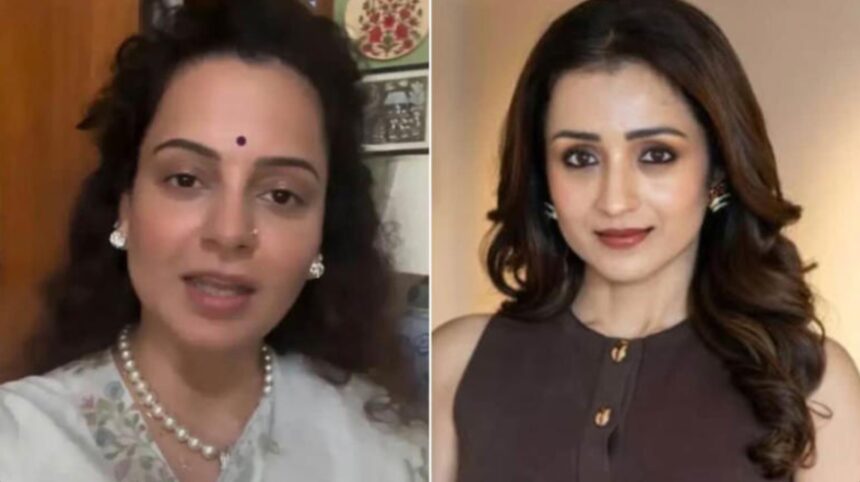
BJP MP and actor Kangana Ranaut has spoken out against the practice of attacking women’s character during public and political controversies. Referring to the ongoing row involving Tamil actor Trisha and Tamil Nadu politics, Ranaut said women are often targeted with personal attacks even when a dispute involves more than one party.
Kangana Ranaut has once again raised the issue of how women are treated during public controversies, arguing that character assassination remains a common way of discrediting women.
Speaking to reporters in Kullu on Monday after chairing a District Development Coordination and Monitoring meeting, the actor-turned-politician referred to the controversy involving Tamil actor Trisha and remarks allegedly made by Tamil Nadu Deputy Chief Minister and DMK leader Udhayanidhi Stalin.
Ranaut argued that personal attacks frequently fall disproportionately on women, particularly when their professional success or public position makes them prominent targets.
See more of our coverage in your search results.
Add Hunterfly on GoogleKangana Ranaut references Trisha controversy
While discussing the issue, Ranaut referred to the controversy in Tamil Nadu involving Trisha.
“You have seen what happened in Tamil Nadu, where a very respected artist and actress was involved in a matter where the relationship was between both parties. However, when it comes to abuses and character assassination, it is always the woman who is targeted,” she said.
Her comments came amid a political and public dispute surrounding remarks allegedly made by Udhayanidhi during a protest meeting related to the Cauvery issue.
The controversy has drawn attention because of allegations that a remark made during the event was derogatory towards Trisha. The DMK has disputed the interpretation, maintaining that the remarks were edited or misrepresented and that Udhayanidhi did not mention the actor by name.
Those competing claims remain central to the controversy.
See more of our coverage in your search results.
Add Hunterfly on GoogleKangana says attacking women’s character is an old tactic
Ranaut broadened her comments beyond the specific Tamil Nadu controversy.
According to the BJP MP, attacking a woman’s character is an established method of attempting to undermine her credibility.
“We all know that this is not limited to India. It exists across the world. Whether a woman is working, successful, a leader, or in a position of power or authority, she is always brought down by attacking her character,” Ranaut said.
See more of our coverage in your search results.
Add Hunterfly on GoogleShe also pointed to her own experience of facing personal attacks in public life.
The actor-turned-politician questioned how long such treatment of women would continue and called for greater introspection within society.
“So, when will this kind of character assassination of women stop? Somewhere, we need to look within ourselves as a society and ask how we view women and whether we truly respect them or not,” she added.
Udhayanidhi Stalin controversy triggers political debate
The Trisha row has developed into a wider political issue in Tamil Nadu.
The alleged remark attributed to Udhayanidhi was reportedly made during an August meeting connected to protests over the Cauvery issue. Critics interpreted the comment as a personal and derogatory reference to Trisha.
The DMK, however, has rejected that interpretation and argued that the clip or remark was edited and presented out of context. The party’s position has been that Udhayanidhi did not take Trisha’s name.
The dispute has consequently involved questions about political speech, personal attacks and the treatment of women in public discourse.
Tamil Nadu leaders speak against abusive remarks targeting women
The controversy has also prompted comments from political leaders in Tamil Nadu.
Tamil Nadu Chief Minister M K Stalin, speaking in the state Assembly, said political opponents could engage in strong criticism but should not make defamatory comments about women.
Actor-turned-politician Vijay, meanwhile, warned that personal attacks, double-meaning remarks and derogatory language directed at women could invite legal consequences.
His comments were widely viewed in the context of the controversy, particularly as political tensions continue around the issue.
The reactions have highlighted a broader debate over where political criticism ends and personal or defamatory attacks begin.
Why Kangana’s comments matter
Ranaut’s intervention adds another national political voice to a controversy that has already generated considerable discussion in Tamil Nadu.
Her argument, however, goes beyond the specific allegations involving Trisha. She framed the issue as part of a wider pattern in which women in professional and public life can become targets of personal attacks when disagreements emerge.
Her comments also reflect a recurring debate in Indian public life: whether criticism of a public figure should focus on their actions and public positions rather than their personal character.
The allegations surrounding the Trisha controversy remain disputed, and the political claims made by the different parties should be considered in that context.