








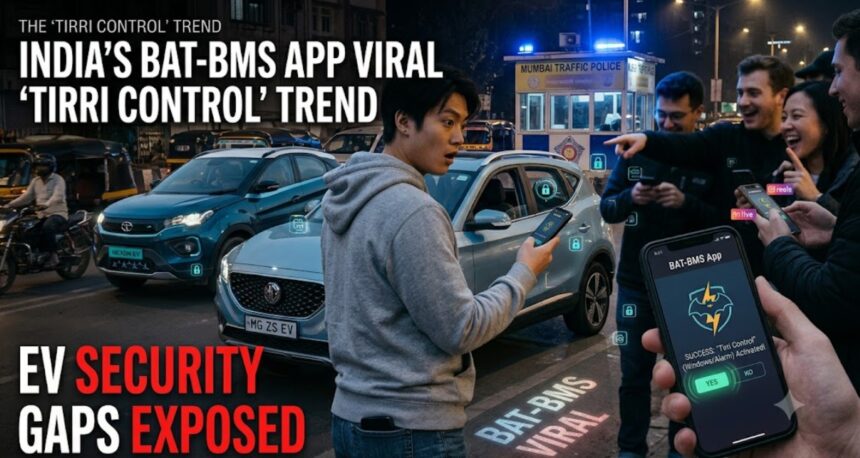
A smartphone application originally designed to monitor lithium batteries has unexpectedly become the center of a viral social media trend in India, raising questions about electric vehicle security and responsible technology use.
The application, known as BAT-BMS, has gained widespread attention after videos surfaced on Instagram, YouTube, X and Reddit showing users allegedly connecting to nearby e-rickshaws and remotely disabling their batteries through Bluetooth.
The trend, often referred to online as “Tirri Control”, has generated millions of views, sparked debates over road safety and highlighted potential vulnerabilities in some low-cost electric vehicle battery systems.
What Is the BAT-BMS App?
BAT-BMS is a legitimate battery management application developed by Chinese technology company Shenzhen Grenergy Technology.
See more of our coverage in your search results.
Add Hunterfly on GoogleThe app is designed to connect wirelessly to compatible Bluetooth-enabled lithium battery packs and provide users with real-time battery information, including:
- Battery charge level
- Voltage
- Current flow
- Temperature
- Battery health
- Charging status
- Cycle life information
It also allows battery owners to manage certain battery functions remotely, including charging and discharging controls.
Battery management systems (BMS) are commonly used in electric vehicles to monitor performance, improve efficiency and protect batteries from damage.
How the Viral Trend Works
According to videos circulating online, some users are exploiting the BAT-BMS application to connect to nearby e-rickshaw battery systems and disable their power output.
The process shown in the videos typically involves:
See more of our coverage in your search results.
Add Hunterfly on Google- Opening the BAT-BMS app
- Scanning for nearby Bluetooth-enabled batteries
- Connecting to a compatible battery
- Disabling the battery’s discharge function
When the discharge function is turned off, power delivery to the motor stops, causing the vehicle to shut down.
Several videos show confused drivers attempting to restart their vehicles after unexpectedly losing power.
However, experts caution that the videos do not prove the app can control all e-rickshaws, and many of the claims circulating online are being exaggerated.
See more of our coverage in your search results.
Add Hunterfly on GoogleCan BAT-BMS Switch Off Any E-Rickshaw?
The simple answer is no.
The application only works under specific conditions.
For BAT-BMS to communicate with a vehicle:
- The vehicle must use a compatible lithium battery pack
- The battery must include a Bluetooth-enabled Battery Management System
- The BMS must support BAT-BMS connectivity
- Bluetooth communication must be active
- Security protections must be weak or absent
Many e-rickshaws in India still operate using lead-acid batteries, which do not support Bluetooth connectivity.
Additionally, numerous lithium-powered vehicles use proprietary battery management systems that require manufacturer-specific applications rather than BAT-BMS.
As a result, the app cannot automatically connect to every electric vehicle on the road.
Why Some Vehicles May Be Vulnerable
The controversy has drawn attention to security practices used in some budget battery systems.
Industry observers note that certain low-cost Bluetooth-enabled Battery Management Systems may ship with:
- Weak default passwords
- No authentication requirements
- Open Bluetooth pairing settings
- Minimal encryption protections
If these protections are not configured properly, nearby users within Bluetooth range—typically around 10 to 15 meters—could potentially gain access to battery controls.
The issue is less about advanced hacking techniques and more about inadequate security implementation at the hardware level.
Cybersecurity specialists have long warned that connected devices require stronger authentication mechanisms to prevent unauthorized access.
Social Media Reactions Divide Opinion
The viral trend has generated mixed reactions online.
Some users have viewed the videos as harmless pranks, often expressing frustration with e-rickshaw driving behavior in congested urban areas.
Others have strongly criticized the trend, arguing that it unfairly targets drivers who rely on their vehicles for daily income.
Several creators have posted videos highlighting the difficulties faced by affected drivers, including situations where drivers reportedly paid strangers for assistance restarting their vehicles.
Critics argue that intentionally disabling working vehicles can create safety risks and cause financial hardship for drivers.
Potential Safety Risks
While many videos appear staged or intended for entertainment, experts warn that disabling a moving electric vehicle could create genuine safety concerns.
Potential risks include:
- Traffic disruptions
- Road accidents
- Sudden vehicle stoppages
- Passenger safety issues
- Loss of driver income
- Public road hazards
If a vehicle loses power unexpectedly in busy traffic conditions, both drivers and passengers could be exposed to dangerous situations.
The incident has renewed discussions about cybersecurity standards for connected transportation systems.
Growing Importance of EV Cybersecurity
As India’s electric mobility sector expands rapidly, cybersecurity is becoming an increasingly important issue.
Modern electric vehicles rely on:
- Connected batteries
- Software-based controls
- Mobile applications
- Wireless communication systems
- Cloud-enabled monitoring tools
Each connected component can potentially create new security challenges if not properly protected.
Industry experts recommend that manufacturers implement:
- Strong password protection
- Multi-factor authentication
- Secure Bluetooth pairing
- Encrypted communication channels
- Regular software updates
Such measures can help reduce the risk of unauthorized access and improve overall vehicle security.
App Availability and Current Status
The BAT-BMS application remains available on the Google Play Store at the time of reporting.
However, reports indicate that the app is no longer listed on Apple’s App Store.
Importantly, the application itself is not inherently malicious. It was developed as a legitimate battery management tool for battery owners and technicians.
The controversy stems from the alleged misuse of certain battery systems rather than the intended purpose of the software.
Outlook
The BAT-BMS controversy serves as a reminder that as vehicles become increasingly connected, cybersecurity must become a core component of product design.
While only a limited number of compatible battery systems may be vulnerable, the viral trend has exposed potential weaknesses in some low-cost electric vehicle components.
For India’s rapidly growing EV industry, the incident highlights the need for stronger security standards, better user awareness and improved protection mechanisms to ensure that connected mobility remains both innovative and secure.
As electric transportation adoption accelerates, cybersecurity will likely become just as important as battery performance, charging infrastructure and vehicle range in shaping the future of the industry.