






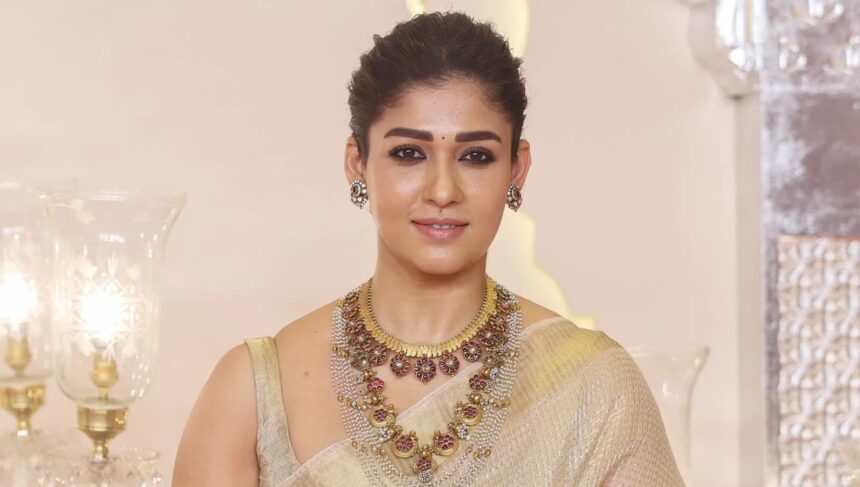
Nayanthara has built one of the most influential careers in contemporary Indian cinema. Working predominantly across Malayalam, Tamil and Telugu films before making a major Hindi-film breakthrough, she has established herself as a leading actor whose career has increasingly included women-centred and performance-driven roles.
Known to fans as the “Lady Superstar,” Nayanthara has combined commercial success with a willingness to headline films in which female characters drive the story. Her journey from her Malayalam debut to major Tamil blockbusters and her pan-Indian success with Jawan reflects the changing position of women in Indian mainstream cinema.
Early Life and Entry Into Films
Nayanthara was born Diana Mariam Kurian on November 18, 1984, in Bengaluru, Karnataka. Her family has roots in Kerala, and because her father served in the Indian Army, her childhood involved living in different parts of the country.
She studied in several cities before eventually settling in Kerala with her family. Nayanthara pursued a bachelor’s degree in English literature at Mar Thoma College, Tiruvalla, while also working as a model.
See more of our coverage in your search results.
Add Hunterfly on GoogleHer original plans were not centred on acting. However, an opportunity to appear in the Malayalam film Manassinakkare changed the direction of her career.
Released in 2003, the film became a major success and gave Nayanthara her first significant exposure as an actor.
She subsequently adopted the screen name Nayanthara, and her career began moving rapidly across the South Indian film industry.
Nayanthara’s Rise Across South Indian Cinema
After making her Malayalam debut, Nayanthara entered Tamil cinema with Ayya in 2005.
The same period also saw her appearing in major projects such as Chandramukhi and Ghajini, helping establish her as a recognisable face among Tamil audiences.
See more of our coverage in your search results.
Add Hunterfly on GoogleShe later expanded into Telugu cinema with Lakshmi in 2006 and made her Kannada debut with Super in 2010.
Her early filmography included commercially successful titles such as Vallavan, Billa and Villu.
Her performance as Sita in the Telugu film Sri Rama Rajyam earned her a Nandi Award, further strengthening her credentials as a performer.
See more of our coverage in your search results.
Add Hunterfly on GoogleA Difficult Period in Her Personal Life
Nayanthara’s rising professional career was accompanied by intense public interest in her personal life.
Her reported relationship with actor and choreographer Prabhu Deva, who was married at the time, generated considerable media attention and public criticism.
The controversy became an emotionally difficult period for the actress, and she subsequently stepped away from acting for a period.
Her return would mark a significant turning point.
Nayanthara’s Strong Comeback
After her break from films, Nayanthara returned with projects that increasingly demonstrated her ability to occupy the centre of a story.
Raja Rani in 2013 became an important commercial success, followed by films including Naanum Rowdy Dhaan, Aramm, Immaikkaa Nodigal and Sye Raa Narasimha Reddy.
These projects helped redefine her image beyond conventional romantic roles.
She increasingly became associated with characters who possessed agency, ambition and narrative importance.
Nayanthara and Women-Centred Cinema
One of the most significant aspects of Nayanthara’s career has been her participation in films built around female protagonists.
Projects such as Anaamika, Maya, Kolamaavu Kokila, Netrikann and Annapoorani: The Goddess of Food placed her at the centre of their respective stories.
In Maya, she played a single mother in a supernatural thriller.
Kolamaavu Kokila followed a woman who becomes involved in drug smuggling while trying to support her family.
In Netrikann, Nayanthara took on a challenging role involving a visually impaired police officer.
These films contributed to her reputation as an actor capable of carrying films without relying entirely on a male star as the central attraction.
Bollywood Debut With Jawan
Nayanthara made her major Hindi-film debut in 2023 with Jawan, opposite Shah Rukh Khan.
Directed by Atlee, the action thriller was conceived as a pan-Indian commercial spectacle and featured a cast drawn from different parts of India’s film industries.
Nayanthara played a key role in the film as a police officer and single mother.
The enormous commercial success of Jawan introduced her to an even wider Hindi-speaking audience and cemented her position as a pan-Indian star.
Her casting was also significant because it brought one of Tamil cinema’s biggest female stars into a major Hindi production without abandoning the cross-regional identity that had defined much of her career.
Nayanthara and the Changing Position of Women in Cinema
Nayanthara’s career is particularly notable within an industry historically dominated by male stars.
Her sustained commercial value as a female lead has challenged the assumption that actresses can only attract audiences when paired with a major male protagonist.
Her women-led films have also demonstrated that female characters can occupy different genres, including action, thriller, horror, drama and social stories.
This has helped make Nayanthara an important figure in conversations about female stardom in South Indian cinema.
Nayanthara: Beyond the Fairytale
Nayanthara and filmmaker Vignesh Shivan, whom she married in 2022, are associated with the production company Rowdy Pictures.
Her personal and professional journey became the subject of the Netflix documentary Nayanthara: Beyond the Fairytale.
The documentary explored her career, relationships, marriage and experiences within the film industry.
It also gave viewers a more personal perspective on the pressures she experienced as a public figure.
Nayanthara on Body-Shaming and Public Judgment
One of the more revealing aspects of the documentary was Nayanthara’s discussion of the criticism she faced early in her career.
She recalled receiving harsh comments about her appearance, particularly during the period surrounding Ghajini.
Speaking about the experience, she said:
“The lowest point was the film Ghajini. There were days when I used to see all these comments and people were like, ‘Why is she even acting?’ ‘Why is she even there in the film?’ ‘She is so fat.’”
Nayanthara also discussed what she viewed as a gender imbalance in the way celebrities’ personal lives are judged.
She pointed to the difference between the scrutiny faced by actresses and male actors when relationships become subjects of public discussion.
Her comments offered insight into the pressures surrounding female performers in an industry where appearance and personal life are often subjected to intense public commentary.
Nayanthara and the Dhanush Copyright Dispute
Another major chapter in Nayanthara’s public life emerged after the release of her documentary.
Dhanush, who was associated with the production of Naanum Rowdy Dhaan, initiated legal proceedings concerning footage used in Nayanthara: Beyond the Fairytale.
The dispute centred on behind-the-scenes footage from the film that appeared in the documentary.
Nayanthara subsequently published an open letter explaining her position and describing her attempts to obtain permission for material connected to Naanum Rowdy Dhaan.
The disagreement became a major entertainment-industry story and sparked wider discussions about copyright, creative ownership and power dynamics within the film business.
Because the matter involves legal claims and competing positions, those allegations should be understood in the context of the parties’ respective public statements and court proceedings rather than treated as established facts.
Nayanthara’s Continuing Career
Nayanthara has continued to work across major Indian film industries, taking on projects in Tamil, Telugu and Malayalam cinema while maintaining a strong pan-Indian profile.
Her career has evolved from conventional commercial roles to projects that frequently place female characters at the heart of the narrative.
That evolution has helped transform her public image from a popular South Indian actress into one of India’s most recognisable female film stars.
Why Nayanthara Remains an Influential Star
Nayanthara’s career is not defined by a single blockbuster or one particular genre.
Instead, her influence has developed over more than two decades through a combination of commercial films, women-led projects, multilingual performances and an ability to remain relevant through different phases of Indian cinema.
Her journey also reflects the growing importance of regional film industries within the broader Indian entertainment landscape.
From Malayalam cinema to Tamil blockbusters and a major Hindi debut, Nayanthara has consistently expanded her audience while maintaining a distinct identity.
That combination of longevity, commercial appeal and female-led storytelling is central to the legacy behind her Lady Superstar title.