






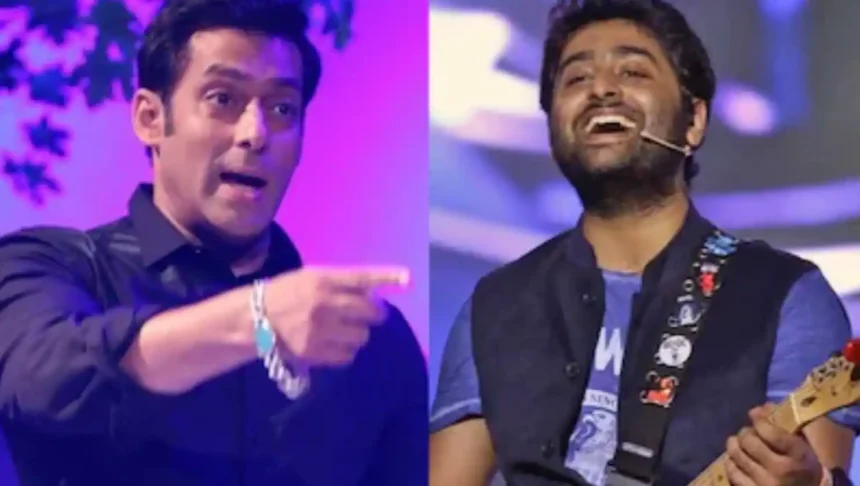
When Arijit Singh announced his retirement from playback singing earlier this week, the decision felt abrupt—but not entirely disconnected from his past. Just days before the announcement, his voice featured in Maatrubhumi, a song from Salman Khan’s war drama Battle of Galwan. If this indeed turns out to be Arijit’s final playback track, it closes a remarkable, complicated, and deeply symbolic chapter—one in which Salman Khan played an unexpectedly pivotal role.
For an artist known for shunning the spotlight, Arijit Singh’s career has often been shaped as much by silence as by sound. Yet one of the most talked-about episodes of his professional life unfolded loudly, publicly, and painfully—beginning with a moment of on-stage banter that spiraled into years of speculation.
When a Joke Changed the Narrative
In 2014, Arijit Singh was at the peak of an extraordinary run. Following Tum Hi Ho from Aashiqui 2, his voice dominated Bollywood soundtracks with hits like Suno Na Sangemarmar, Mast Magan, Humdard, and Muskurane. Exhausted but unstoppable, Arijit walked on stage to receive a Best Playback Singer award—handed to him by Salman Khan, the host of the evening.
In a moment meant as light-hearted banter, Salman quipped, “Soye nahi kya?” (Didn’t you sleep?). Arijit replied, “Aap logon ne sula diya” (You people put me to sleep).
See more of our coverage in your search results.
Add Hunterfly on GoogleThe exchange was brief, awkward, and quickly forgotten—until it wasn’t.
The Sultan Fallout
Two years later, in 2016, Arijit shared a now-infamous post on X (then Twitter), publicly apologising to Salman Khan and revealing that his version of Jag Ghoomeya from Sultan had been dropped from the film. The singer pleaded for reconciliation, writing that he had tried to apologise privately and asking that the song not be removed.
The post was deleted, but the damage—and curiosity—remained.
Salman Khan never addressed the issue publicly at the time. Arijit, true to form, withdrew further into his music, letting his work speak. Despite the controversy, his career soared. Chartbusters continued. Awards followed. The industry moved on—but the perceived rift lingered as Bollywood’s most whispered cold war.
A Quiet Reunion
Seven years later, something changed.
See more of our coverage in your search results.
Add Hunterfly on GoogleIn 2023, Arijit Singh lent his voice to two songs in Tiger 3—Ruaan and Leke Prabhu Ka Naam—both starring Salman Khan and Katrina Kaif. Salman promoted the tracks enthusiastically, and for the first time, there was visible warmth between the two names.
Then came the moment that rewrote the narrative.
Salman Khan Breaks the Silence
During a Bigg Boss 19 episode last year, Salman Khan finally addressed the long-speculated feud.
See more of our coverage in your search results.
Add Hunterfly on Google“Arijit aur main bahut acche dost hain. Woh misunderstanding mere side se hui thi,” Salman said, taking ownership of the past. He confirmed Arijit had sung for him in Tiger 3 and would do so again in Battle of Galwan.
It was an unusually candid admission from Bollywood’s biggest star—and, in retrospect, a moment of closure.
The Final Song?
Maatrubhumi from Battle of Galwan was released quietly, without fanfare. Days later, Arijit Singh announced he was stepping away from playback singing altogether.
In a message from his private social media account that later went viral, Arijit reportedly wrote that he “gets bored easily” and wants to seek music that helps him “live.”
Whether Maatrubhumi becomes his final film song remains to be officially confirmed. But symbolically, the timing is striking.
From a dropped track in Sultan to a potential farewell in Battle of Galwan, Salman Khan’s films bookend Arijit Singh’s playback journey in a way few could have predicted.
More Than a Feud, A Full Circle
It would be simplistic—and unfair—to reduce Arijit Singh’s career to one equation. His legacy spans hundreds of songs, multiple languages, and a generation of listeners. Yet the Salman Khan chapter stands out because it mirrors the larger truth about Arijit himself: an artist uncomfortable with spectacle, navigating an industry built on it.
If this is indeed the end of Arijit Singh’s playback era, it ends not in conflict, but reconciliation. Not in bitterness, but reflection.
And perhaps that is the most Arijit Singh ending of all.