

The wedding of Junaid Safdar, grandson of former Pakistan Prime Minister Nawaz Sharif, to Shanzay Ali Rohail has drawn significant public attention, not just for its political lineage but also for the bride’s fashion choices that sparked a lively debate on social media.
The wedding celebrations were held in Lahore and included multiple events such as a mehendi ceremony and the main wedding function. As photos and videos from the festivities circulated widely online, Shanzay Ali Rohail’s outfits—designed by prominent Indian couturiers—became a focal point of discussion.
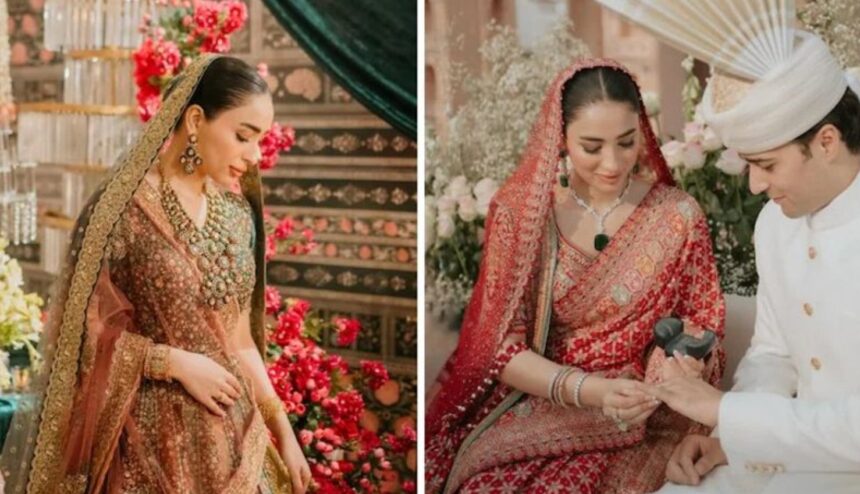
Sabyasachi Lehenga for Mehendi, Tarun Tahiliani Saree for Wedding
For the mehendi ceremony, Shanzay wore an emerald green lehenga by Indian designer Sabyasachi Mukherjee, featuring intricate traditional embroidery and paired with coordinated jewellery. For the main wedding ceremony, she opted for a red saree designed by Tarun Tahiliani, another celebrated name in Indian fashion.
According to reports, Shanzay Ali Rohail is the granddaughter of Rohail Asghar, a longtime political associate of Nawaz Sharif. While the wedding was a private family affair, its visuals quickly gained traction across social platforms, particularly due to the cross-border fashion choices.
See more of our coverage in your search results.
Add Hunterfly on GoogleNetizens React: Praise, Criticism, and Defence
Under a post shared by Dialogue Pakistan on Instagram, users expressed mixed reactions. Some questioned the decision to wear Indian designers at a high-profile Pakistani wedding.
One user commented, “Very mid. I’m sure Pakistani designers could have made her something more Pakistani, but well…” Another wrote, “What’s this obsession with Indian designers? They drool over our Pakistani clothes and look at this!”
However, many users came forward in strong defence of the bride, emphasising personal choice and artistic exchange across borders.
“Indians wear Pakistani designers and vice versa. Why can’t we appreciate and promote our designers?” one supporter noted. Another comment read, “It’s 2026—can we stop judging brides for what they choose to wear on their own wedding day?”
A further response added pointedly, “For God’s sake, it’s her wedding. She can wear whatever she wants. I can bet 90% of the women criticising secretly wished they had Sabyasachi at their wedding.”
See more of our coverage in your search results.
Add Hunterfly on GoogleFashion, Identity, and Cross-Border Influence
The debate highlights the continued cultural interplay between Indian and Pakistani fashion, where designers from both countries enjoy admiration beyond national boundaries. While the choice sparked criticism from some quarters, it also reignited conversations around personal expression, cultural exchange, and modern wedding aesthetics in South Asia.
Despite the online discourse, Shanzay Ali Rohail’s bridal looks were widely shared and discussed, cementing the wedding as one of the most talked-about high-profile ceremonies of the year.