







Festive fashion does not always need pastel palettes or understated neutrals to feel sophisticated. Sometimes, the strongest statement comes from a saturated jewel tone, traditional craftsmanship and styling that knows exactly when to stop.
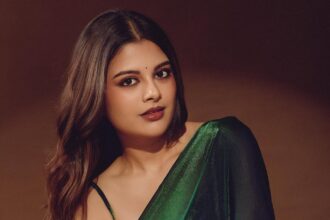
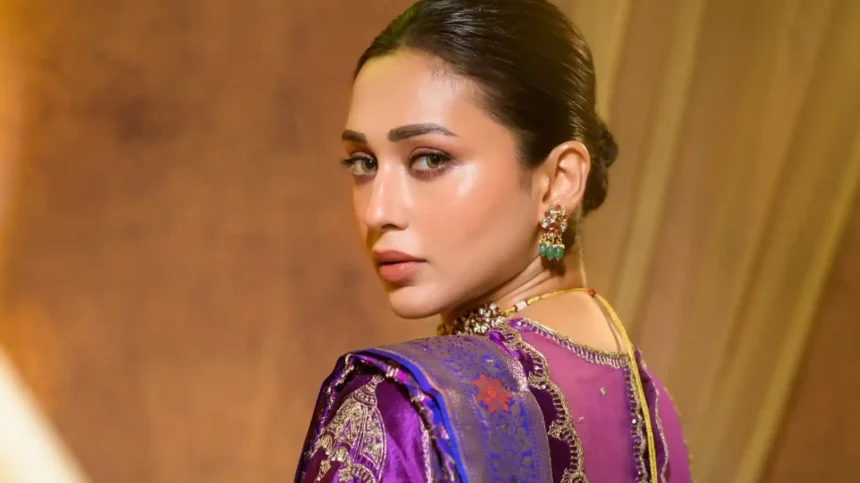
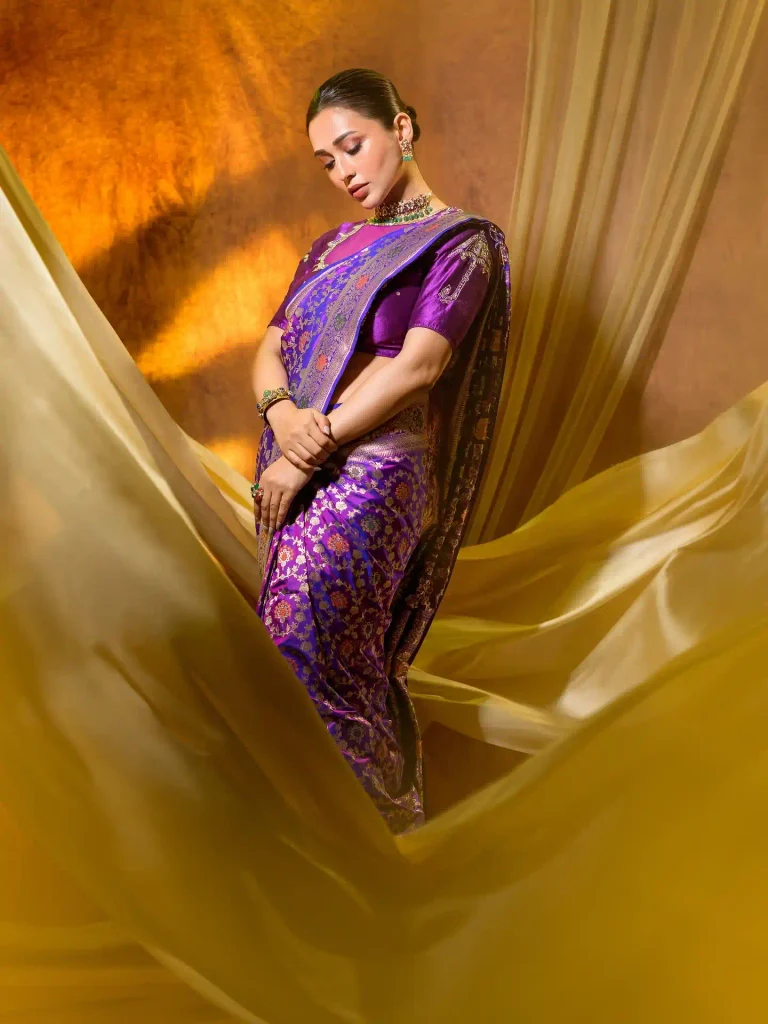
Mimi Chakraborty embraces that approach in a striking violet and royal-blue silk saree, creating a look that brings together the richness of Indian textile traditions and the sharper sensibility of contemporary occasionwear.
The combination of deep violet, sapphire blue and warm gold creates immediate visual impact, while the structured blouse and carefully selected jewellery prevent the ensemble from feeling overly traditional.
Rather than allowing every element to compete for attention, the styling establishes a clear hierarchy: the saree provides the colour and textile drama, the blouse introduces a modern silhouette, and the jewellery adds heritage character.
The result is a sophisticated festive look with unmistakable Tollywood glamour.
Violet Silk Creates the Foundation
The saree’s deep violet tone immediately establishes its personality.
Violet sits naturally within the jewel-tone family, making it particularly effective for evening celebrations and festive occasions. Unlike softer lavender or pastel purple, a saturated violet carries greater visual weight and works especially well with metallic gold detailing.
The silk base adds another layer of richness.
Silk reflects light differently across its folds, allowing the colour to shift subtly as the saree moves. When combined with zari motifs, this creates the dimensional quality that makes traditional Indian occasionwear so visually compelling.
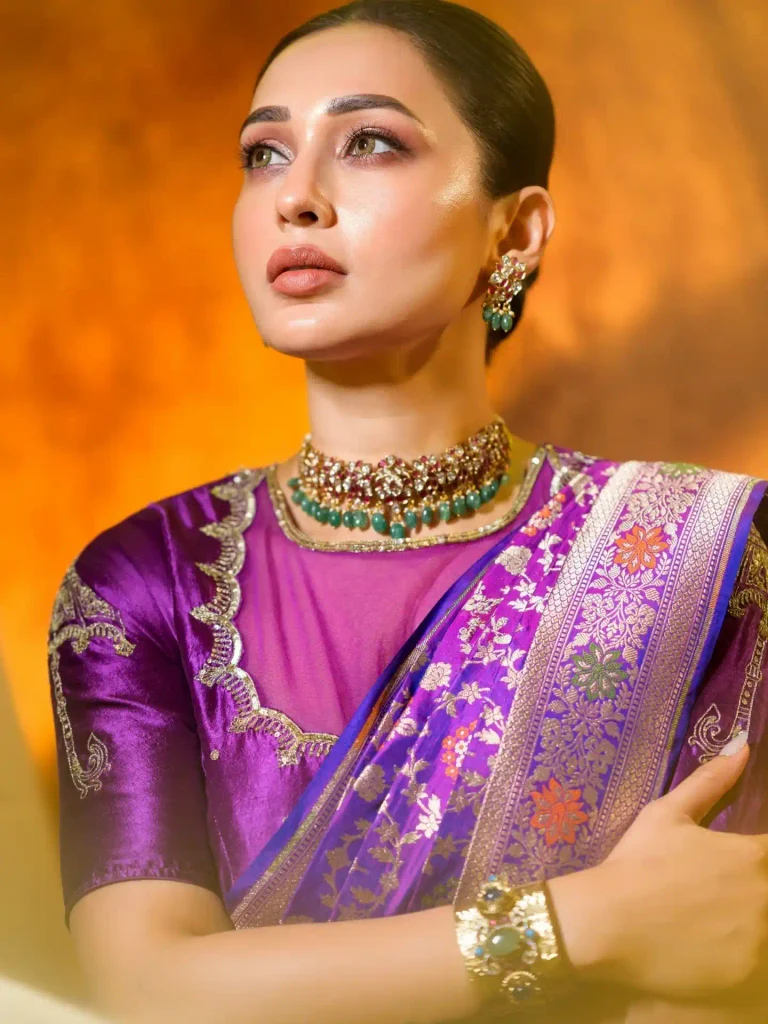
The saree is described as a Banarasi-style silk brocade, featuring intricate floral zari work and a contrasting royal-blue and gold border.
That contrast is important.
Instead of using a single uninterrupted shade, the blue border frames the violet body and gives the drape a more defined finish.
The Royal-Blue and Gold Border Adds Contrast
The sapphire-blue border introduces a second jewel tone without disrupting the overall colour story.
Violet and blue are close enough to feel harmonious but different enough to create separation. Gold then acts as the bridge between them.
This three-colour relationship gives the ensemble its festive character.
The gold zari catches the light, while the blue border creates a visual boundary around the violet silk.
For anyone recreating a similar look, this is a useful colour strategy: choose one dominant jewel tone, introduce a closely related secondary shade and use metallic detailing to connect the palette.
The Blouse Brings the Look Into the Present
The blouse provides the strongest contemporary counterpoint to the traditional saree.
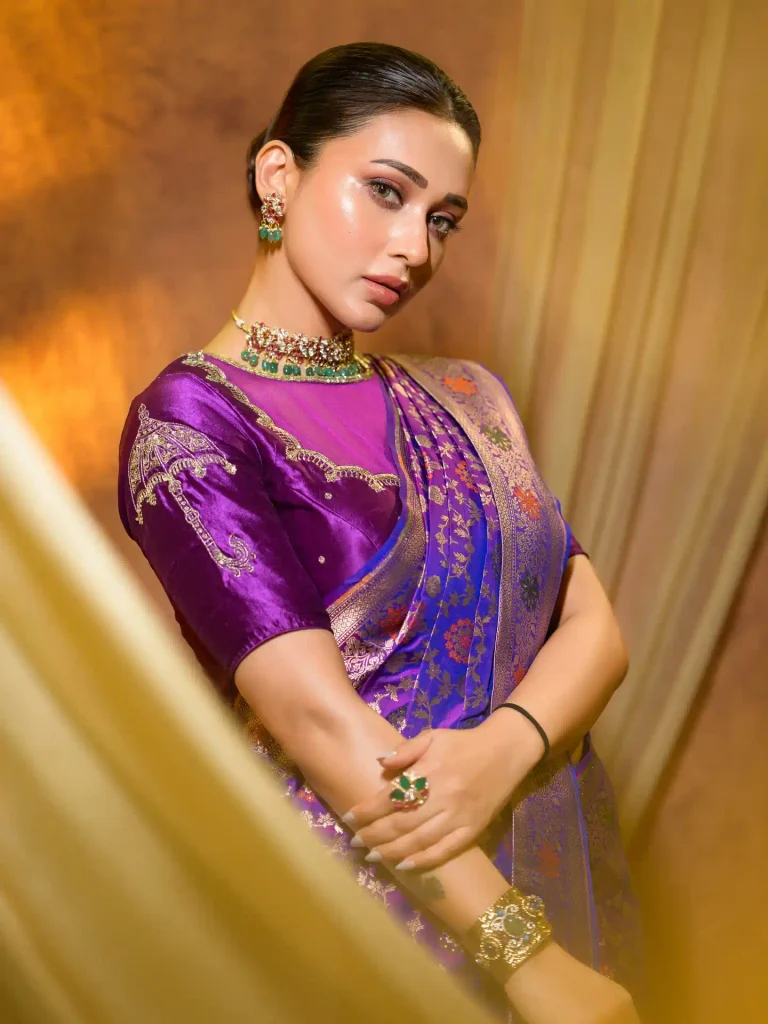
A sheer-illusion neckline and delicate scalloped embroidery create a lighter visual transition between the garment and the face, while detailed sleeves retain the richness expected from festive couture.
The open-back dori construction adds another modern element.
This combination demonstrates why blouse design has become such an important part of contemporary saree styling.
The saree itself may be rooted in centuries-old dressing traditions, but the blouse determines how modern or traditional the final appearance feels.
A more conventional blouse would push this outfit toward classic festive dressing.
The sheer panels and structured construction instead give it a fashion-forward edge.
Why Sheer Detailing Works With Heavy Silk
Dense silk brocade already has considerable visual weight.
Adding equally dense embellishment to every part of the blouse could make the outfit feel heavy.
Sheer fabric solves that problem.
Transparent or semi-transparent panels allow the skin to become part of the visual composition, creating negative space between the embroidered sections.
This is an increasingly common technique in contemporary Indian occasionwear because it preserves the richness of traditional textiles while giving the overall silhouette more lightness.
The principle is simple:
The heavier the textile, the more valuable controlled negative space can become.
Heritage Jewellery Completes the Royal Mood
The jewellery follows the saree’s traditional character rather than trying to modernise it completely.
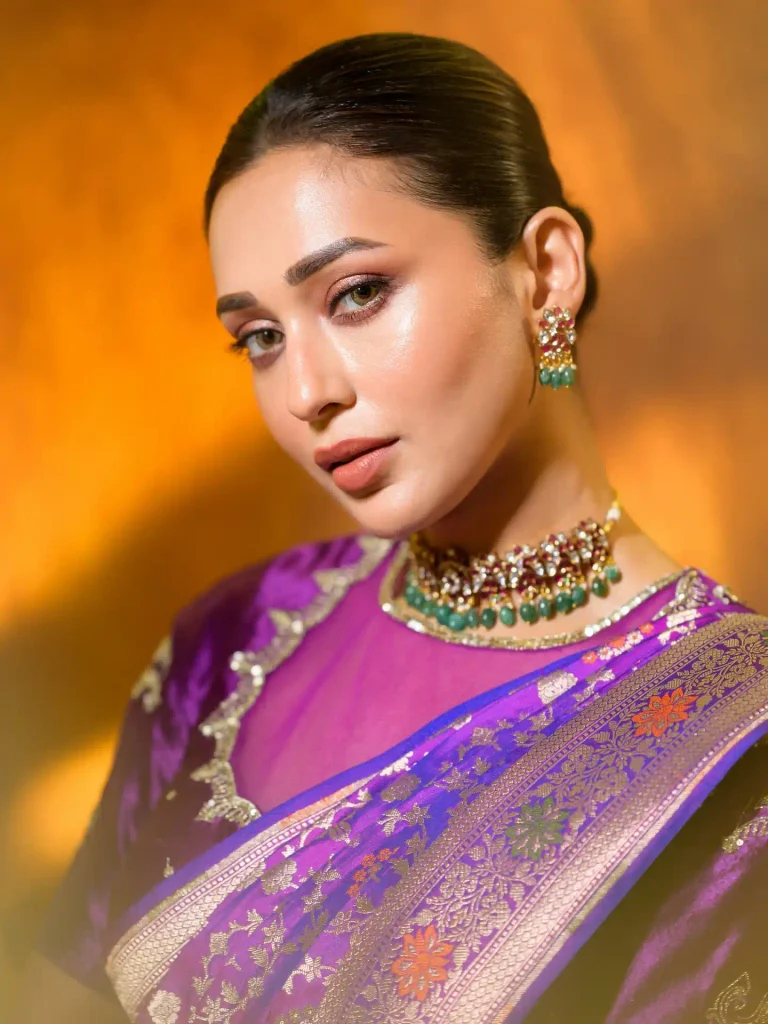
A heritage-inspired uncut polki choker provides the primary statement around the neckline, with ruby accents and emerald-green bead drops adding further colour.
The combination of ruby, emerald, gold and violet creates a distinctly regal palette.
Yet the styling remains controlled because the earrings are comparatively restrained.
This is an important decision.
The saree already contains substantial visual information through its brocade and border. The blouse introduces sheer detailing. Adding oversized earrings, multiple necklaces and stacked bracelets could easily overwhelm the look.
Instead, the choker becomes the hero jewellery piece.
Ruby and Emerald Details Add Depth
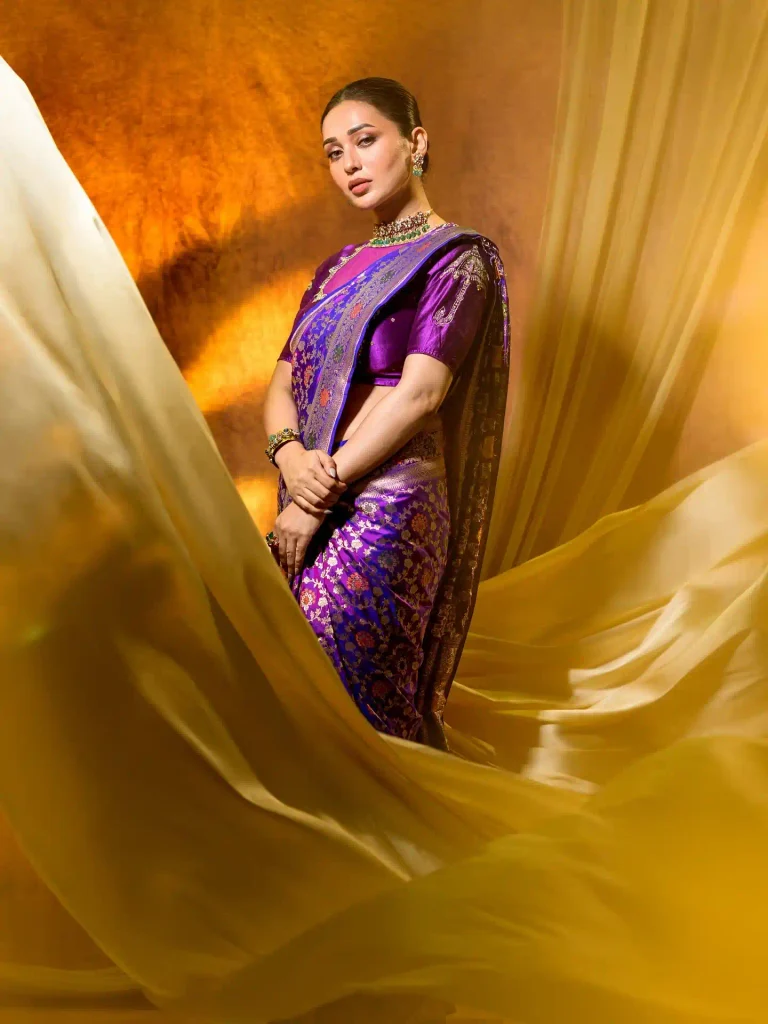
The jewellery’s gemstone colours also complement the saree without exactly matching it.
Ruby introduces warmth.
Emerald brings a cooler green contrast.
Gold connects the jewellery with the zari work.
This creates a more sophisticated effect than attempting to match every accessory precisely to the colour of the saree.
For festive dressing, complementary colours often create more depth than strict colour matching.
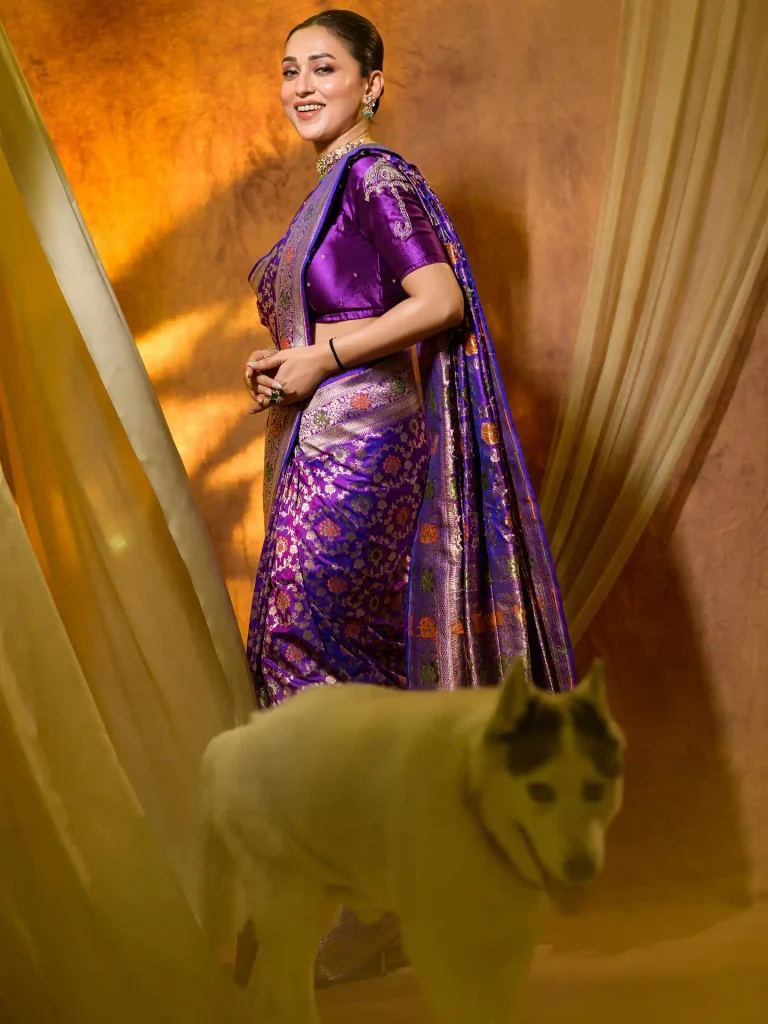
The Vintage Gold Cuff Adds Character
A statement vintage-inspired gold cuff reinforces the heritage mood while balancing the visual weight of the choker.
It also gives the ensemble an additional point of interest without introducing another necklace or heavily layered accessory.
This is an effective approach when styling ornate sarees.
Rather than accumulating jewellery everywhere, distribute the strongest accents strategically across the body.
A statement piece near the face and another at the wrist can be enough.
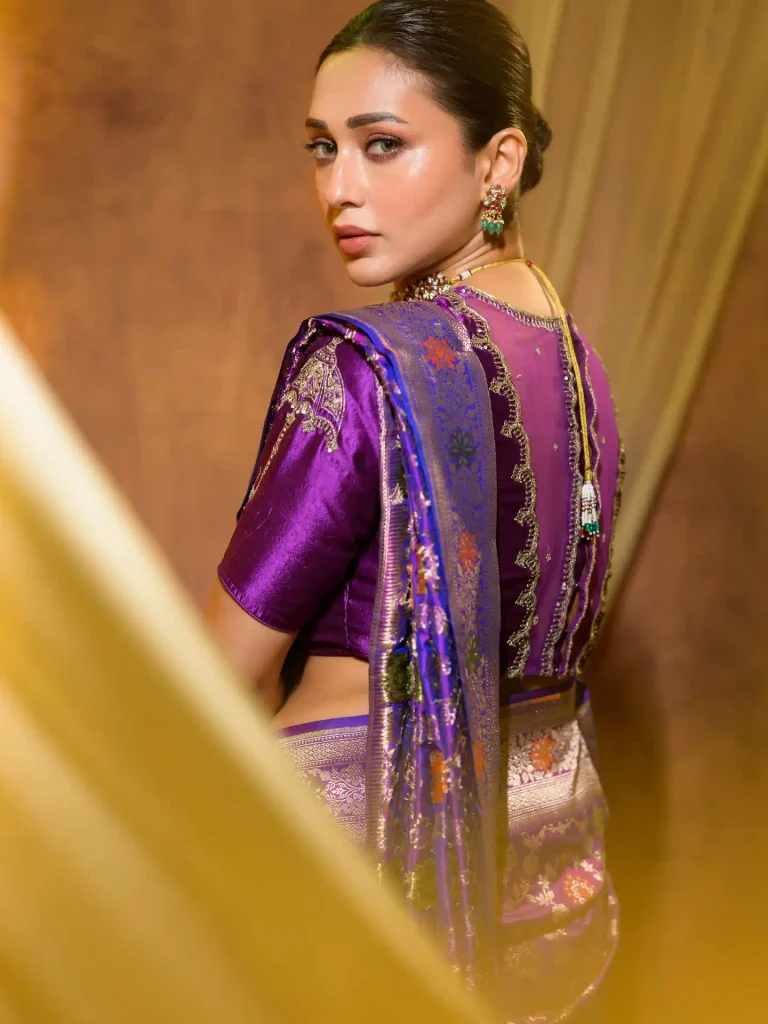
The Beauty Look Keeps the Jewel Tones in Focus
With violet, blue, gold and gemstone jewellery already creating a rich palette, the beauty styling benefits from restraint.
A luminous complexion provides a fresh base, while soft smoky eye makeup adds definition.
Defined eyeliner gives the eyes structure without requiring an excessively dramatic colour.
Sculpted brows further frame the face, while a nude-mauve lip introduces colour without competing with the saree.
The overall effect is polished and sophisticated.
The makeup does not attempt to create another focal point.
Instead, it supports the jewellery and clothing.
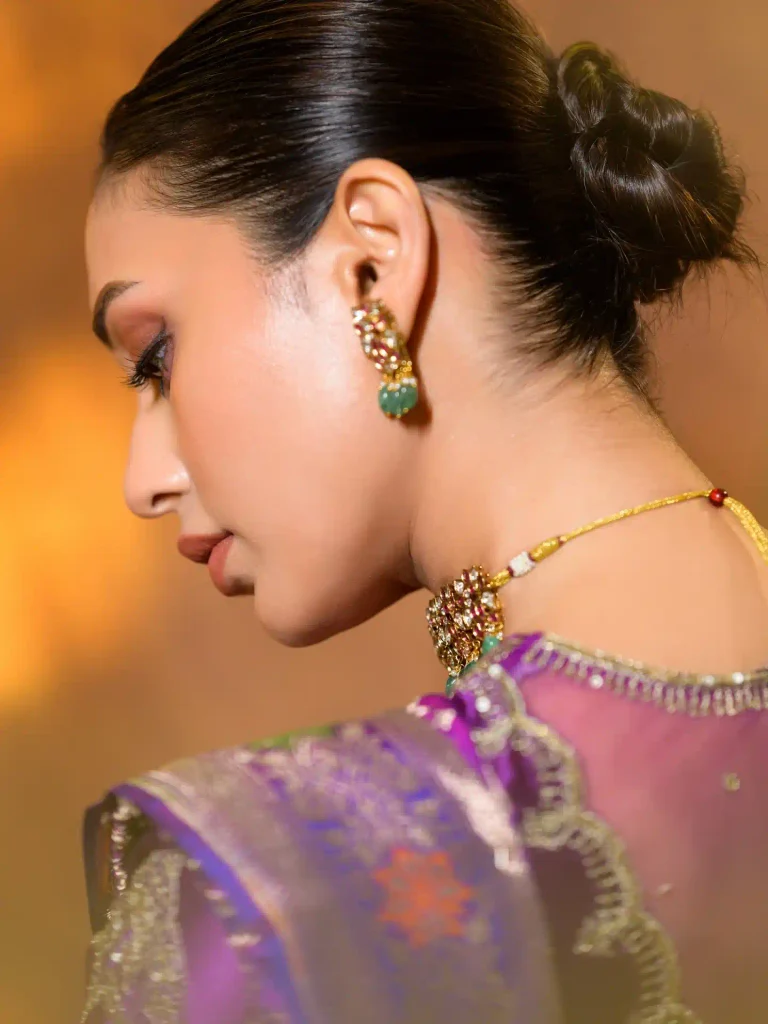
The Low Braided Bun Highlights the Neckline
Hair is another important component of the styling.
A neat, middle-parted low braided bun keeps the shoulders and neckline visible.
This works particularly well with an embellished blouse because loose, voluminous hair could cover some of the detailing.
The pulled-back hairstyle also creates a cleaner frame around the face and allows the statement choker to remain clearly visible.
It is a useful styling formula for sarees with elaborate necklines:
When the blouse is doing the visual work, let the hairstyle create space around it.
Jewel Tones Over Pastels
Pastel sarees continue to have a strong place in contemporary Indian fashion, but jewel tones offer a different kind of occasionwear statement.
Deep violet, emerald, sapphire and ruby shades tend to photograph particularly well under evening lighting because their saturation provides greater visual depth.
Gold detailing further enhances that effect.
For festive events after sunset, jewel tones can therefore provide a naturally dramatic alternative to softer colour palettes.
The key is to avoid introducing too many competing shades.
Two dominant colours plus metallic detailing can often create a more sophisticated result than a rainbow of accents.
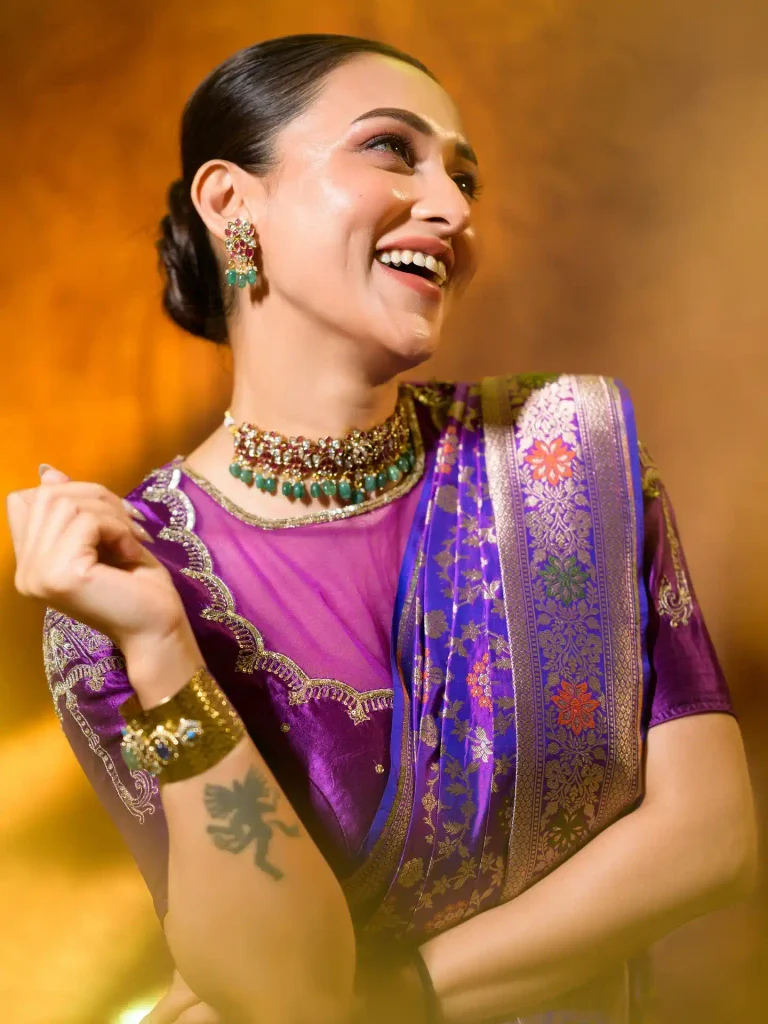
How to Recreate the Look
You do not need to reproduce every element of Mimi Chakraborty’s styling to capture its essence.
Choose a Rich Base Colour
Start with violet, royal blue, emerald, ruby or another deep jewel tone.
For a more subtle interpretation, choose a darker version of the colour.
Add Metallic Craftsmanship
Gold zari, antique-gold embroidery or subtle metallic threadwork can provide the festive dimension.
Keep the metallic detailing consistent across the saree and accessories.
Modernise the Blouse
A sheer neckline, contemporary sleeve, structured bust or modern back detail can transform a traditional saree into a more current ensemble.
Select One Statement Jewellery Piece
A polki choker, statement earrings or heritage necklace can become the focal point.
Avoid making every jewellery piece equally elaborate.
Keep Hair Controlled
A low bun, braided bun or sleek ponytail can expose the neckline and preserve the visual architecture of the outfit.
Use Makeup as a Supporting Element
A luminous base, softly defined eyes and a neutral or mauve lip can complement a jewel-toned saree without competing with it.
When to Wear a Violet Silk Saree
A richly embellished violet silk saree can work across several formal occasions.
It is particularly suited to:
- Wedding receptions
- Festive celebrations
- Diwali gatherings
- Evening parties
- Cultural events
- Fashion events
- Traditional ceremonies
- Red-carpet appearances
- Formal social occasions
For daytime events, reduce the amount of heavy jewellery and choose softer makeup.
For evening celebrations, the combination of silk, zari, polki and gemstone jewellery can create a more dramatic effect.
The Modern Saree Is About Balance
The most interesting contemporary saree styling does not necessarily abandon tradition.
Instead, it edits it.
The saree remains recognisably Indian.
The textile retains its heritage character.
The jewellery references traditional craftsmanship.
But the blouse, hairstyle, makeup and proportions bring the entire look into a modern context.
That balance is what gives the ensemble its appeal.
It demonstrates that traditional clothing can remain culturally rooted while still participating in contemporary fashion.
Why the Look Has Editorial Value
Celebrity fashion coverage becomes more useful when it goes beyond simply describing what someone is wearing.
The real value lies in explaining why the styling works.
In this case, several principles are particularly transferable:
- Jewel tones create stronger evening impact than many pastel palettes.
- Silk provides depth through natural light reflection.
- A contrasting border can define the saree’s silhouette.
- Sheer blouse panels introduce negative space.
- Statement jewellery works best when other accessories are restrained.
- Pulled-back hair can highlight an elaborate neckline.
- Complementary colours often create more sophisticated styling than exact matching.
These are practical ideas readers can apply to their own wardrobes.
The Final Style Lesson
Mimi Chakraborty’s violet-and-blue silk saree look demonstrates that festive elegance does not have to mean choosing between traditional and contemporary fashion.
The strongest outfits can do both.
The rich violet silk provides heritage and drama. The sapphire-blue border creates contrast. Gold zari brings festive luminosity. The contemporary blouse introduces structure and transparency. Polki jewellery establishes the regal mood, while the sleek braided bun keeps the final composition clean.
Nothing feels accidental.
The look is luxurious because it is layered with craftsmanship, but it remains modern because those layers are carefully edited.
For anyone planning a statement festive wardrobe, the takeaway is straightforward:
Start with one powerful colour, let the textile provide the richness, modernise the blouse, choose one dominant jewellery statement and keep the beauty styling clean.
That is how a traditional silk saree can become a distinctly contemporary expression of festive royalty.
ALSO READ:
- Nayanthara Explains Her Rare Promotional Appearance for ‘Toxic’: ‘Yash Just Made a Call’
- Vaaishnavi Prajapati Opens Up About Emotional Impact of Ragging Track in ‘Ganga Mai Ki Betiyan’
- Vijay’s Wife Withdraws Divorce Petition: What Happens Next for the Tamil Actor-Politician?
- Bella Thorne to Write and Direct ‘Spring Breakers 2’: ‘Spring Break Forever’
- Richa Chadha Unveils First Look of ‘Musafiri’, Her Non-Fiction Debut Celebrating Mumbai
- Nauheed Cyrusi Tries Viral Rice Cracker Tiramisu: ‘Really Wanted to Like This’
- Kiara Advani Calls ‘Toxic’ a Career Turning Point: ‘There Will Be a Kiara Before and After This Film’
- Samara Weaving Reportedly Joins Marvel’s X-Men Reboot as Emma Frost
- Tamannaah Bhatia joins Sitaare Gold & Diamonds as brand ambassador; Hyderabad jeweller eyes expansion
- Tamannaah Bhatia launches Tamannaah Fine Jewellery, bringing everyday luxury into focus
- Kritika Kamra Says Handloom Should Be Worn Every Day, Not Just on Special Occasions
- Varun Dhawan and Natasha Dalal Reportedly Passed a Society Interview Before Moving Into Their New Mumbai Home